


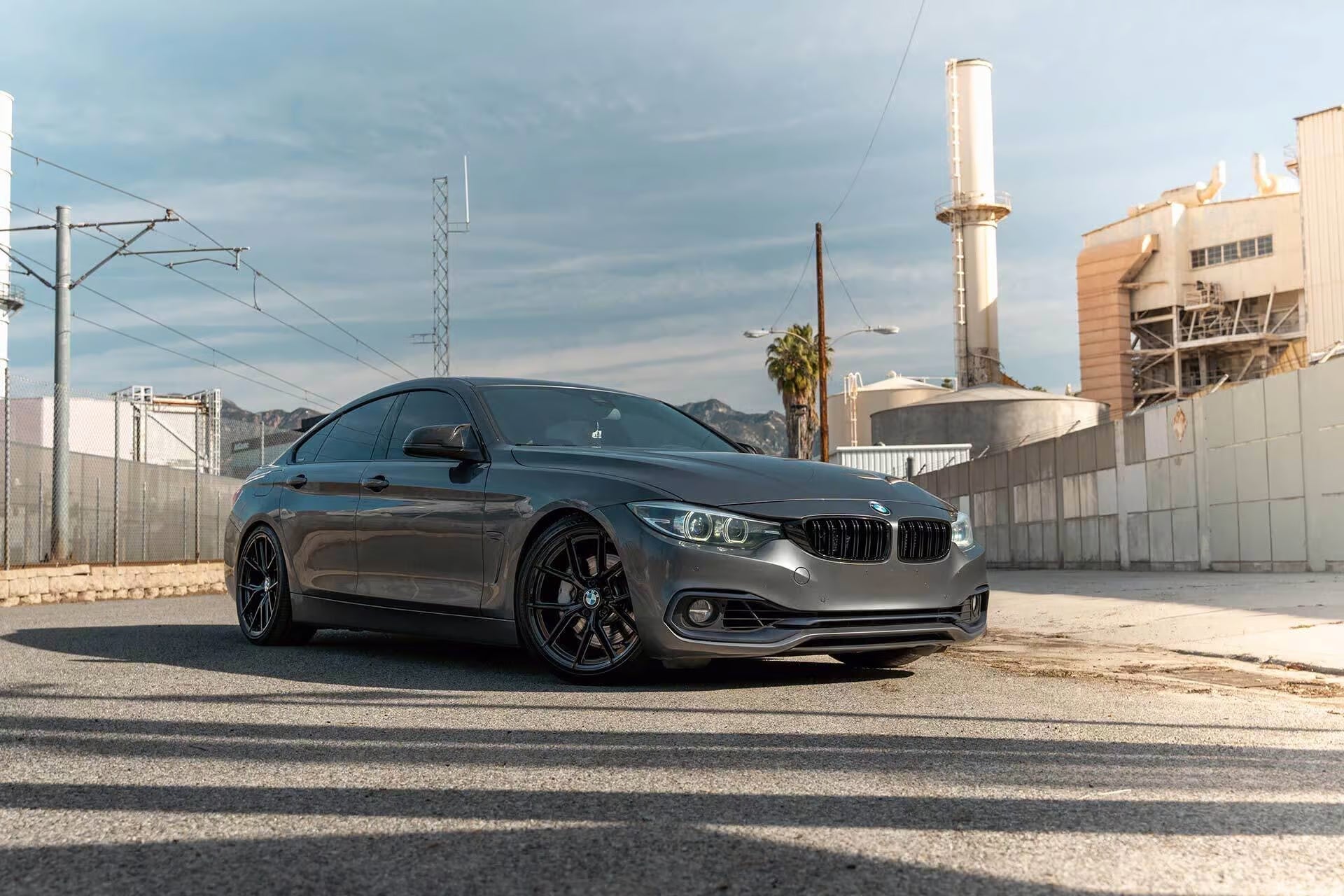
TLDR: The BMW 4 Series shares its audio architecture with the 3 Series, but the coupe, convertible, and Gran Coupe body styles have different speaker locations and counts from the sedan. F32 and F36 owners with Harman Kardon have the same S688A system as the F30, but with fewer speakers due to body style differences.
Stage One replaces factory drivers with OEM-matched components and no coding required. The Ghost Subwoofer fits select 4 Series platforms. Here's the complete guide by body style.
The BMW 4 Series doesn't get as much attention in audio upgrade discussions as the 3 Series, which is partly why it's worth writing about specifically.
The F32 coupe, F33 convertible, and F36 Gran Coupe all share the F30 platform underneath. They use the same audio option codes. But the speaker layouts are different across the body styles, and that matters when you're ordering an upgrade kit.
A post written for the F30 sedan doesn't tell you where your speakers are if you're driving an F33 convertible.
This guide covers each body style separately, what the factory system delivers, and what Stage One and the Ghost change for 4 Series owners specifically.
The Body Style Difference Nobody Talks About
Here's the thing that surprises most 4 Series owners when they start researching audio upgrades.
The F30 3 Series sedan with Harman Kardon gets 16 speakers. The F33 4 Series convertible with the same S688A Harman Kardon option code gets 12 speakers. Same option. Same price. Fewer speakers, because the convertible doesn't have the same rear speaker positions as the sedan does.
A BimmerFest member who owns an F33 laid it out clearly: "You get F30 16 speakers, F33 12 speakers with HK, and only 9 with HiFi. You get a 600-watt amp with HK compared with only 350 with HiFi."
That's a real difference in what you're getting for the same option price, depending on which body style you bought. It's also why looking up generic "BMW 4 Series audio" information often produces answers that don't match what's actually in your car.

F32 Coupe (2014 to 2020)
The F32 is the most common 4 Series body style in the US. Two doors, fastback roofline, rear seats that are usable but not spacious.
Audio configurations: Hi-Fi (S676A) and Harman Kardon (S688A). Base was available on base trim but uncommon on US-spec cars.
Speaker locations:
Hi-Fi: Front door woofer and tweeter, rear side panel speakers, underseat woofer.
HK: Front door woofer and tweeter, rear side panel speakers, underseat woofer, center dash. The HK F32 does not have rear door speakers because there are no rear doors. The speaker count is lower than the F30 sedan HK configuration as a result.
What to know: F32 owners who compare their HK system to an F30 HK system are sometimes surprised by the difference in fullness. The rear fill that sedan owners get from rear door speakers isn't there in the coupe.
Stage One addresses what is there: the front door and tweeter positions, which are where most of the listening experience comes from anyway. The Ghost Subwoofer adds the low-end foundation that makes the coupe system feel complete.
Stage One compatibility: Available for F32 in Hi-Fi and HK configurations. Confirm your kit here.
F33 Convertible (2014 to 2020)
The F33 is the open-top version and the body style where the speaker count difference from the sedan is most pronounced.
Audio configurations: Hi-Fi (S676A) and Harman Kardon (S688A).
Speaker locations:
Hi-Fi: Front door woofer and tweeter, rear side panel speakers. Nine speakers total.
HK: Front door woofer and tweeter, rear side panel speakers, center dash. Twelve speakers total with the 600-watt HK amplifier.
What to know: Convertible audio is its own challenge beyond speaker count. With the top down, road noise and wind noise compete directly with the speakers at any speed above city driving.
The factory HK system in the F33 sounds notably better with the top up than with it down, which is a limitation of cabin acoustics more than speaker quality. Stage One improves the system in both configurations, but the difference is most noticeable with the top-up where the listening environment is controlled.
With the top down, the Ghost Subwoofer is the component that holds the listening experience together. Bass frequencies carry better in open air than mid and high frequencies, which is why systems that sound thin with the top down often improve dramatically with a dedicated subwoofer.
Stage One compatibility: Available for F33 in Hi-Fi and HK configurations. Confirm your kit here.

F36 Gran Coupe (2014 to 2020)
The F36 is the four-door version of the 4 Series coupe. Longer roofline than the F30 sedan, rear seats that are actually usable for adults, and a speaker layout that's closer to the sedan than the coupe.
Audio configurations: Hi-Fi (S676A) and Harman Kardon (S688A).
Speaker locations:
Hi-Fi: Front door woofer and tweeter, rear door woofer, underseat woofer.
HK: Front door woofer and tweeter, rear door woofer and tweeter, center dash, underseat woofer. The F36 gets rear door speakers that the F32 coupe doesn't have, which means the HK speaker count is closer to the F30 sedan than the F32 coupe.
What to know: F36 owners have the most complete factory speaker layout of any 4 Series body style. The rear door tweeters on HK cars add rear fill that the coupe and convertible don't get. Stage One covers all of those positions, and the improvement is consistent across the cabin rather than front-heavy.
Stage One compatibility: Available for F36 in Hi-Fi and HK configurations. Confirm your kit here.

G22 4 Series Coupe (2021 to Present)
The current-generation 4 Series coupe. It shares the G20 3 Series platform, but the coupe body means different rear speaker locations from the sedan.
Audio configurations: Hi-Fi (S676A) and Harman Kardon (S688A).
Speaker locations:
Hi-Fi: Front door woofer and tweeter, rear side panel speakers.
HK: Front door woofer and tweeter, rear side panel speakers, center dash. The G22 HK speaker count is lower than the G20 sedan for the same reason as the F32 versus F30: no rear doors means no rear door speakers.
What to know: G22 owners share the G20's audio architecture, which means the same HK amplifier running at 464 watts. As with the G20, the HK system is capable and underwhelming at the same time. The amp has real output. The factory speakers are the ceiling. Stage One removes that ceiling.
G22 owners who were considering whether to opt for HK and went with it often describe the same experience as G20 HK owners: better than Hi-Fi, not as impressive as expected. Stage One is the post-purchase fix.
Stage One compatibility: Available for G22 in Hi-Fi and HK configurations. Confirm your kit here.

Hi-Fi vs Harman Kardon vs Stage One: 4 Series Summary
| Hi-Fi (S676A) | Harman Kardon (S688A) | Stage One | |
|---|---|---|---|
| F32/G22 speaker count | ~9 | ~12 | Configuration-matched |
| F33 speaker count | 9 | 12 | Configuration-matched |
| F36 speaker count | ~10 | ~14 | Configuration-matched |
| Amplifier | 350W integrated | 600W dedicated (F-series) / 464W (G22) | Not required |
| Tweeter material | Polymer | Polymer | Silk composite |
| Woofer cone | Paper | Paper/polymer | Woven fiberglass |
| Dedicated subwoofer | No | No | Add Ghost |
| Coding required | N/A | N/A | No |
| Reversible | N/A | N/A | Yes |
The Ghost Subwoofer in the 4 Series
No 4 Series factory configuration includes a dedicated subwoofer. The underseat woofers in base and HK configurations produce lower frequencies than the door speakers, but they are not subwoofers.
The Ghost Subwoofer fits select 4 Series platforms. Fitment varies by body style and model year. Use the Build Your Kit tool to confirm Ghost availability for your specific chassis before ordering.
For convertible F33 owners in particular, the Ghost is worth prioritizing. Open-top listening at any speed puts the mid and high frequencies at a disadvantage against wind and road noise. Bass carries better in open air. A system with Stage One and Ghost in an F33 sounds more balanced with the top down than a Stage One-only system because the Ghost provides a low-end foundation that the open cabin environment doesn't strip away.

The 4 Series Install: What to Expect
The F32, F33, and F36 share the F30 door panel removal process with body-style-specific differences in the rear positions.
Tools you need: Trim panel removal tool, T20 Torx bit, Phillips head screwdriver.
F32 coupe: Front doors follow the F30 process. Rear-side panel speakers accessible from inside the cabin without full door panel removal. The install video covers this.
F33 convertible: Front doors are the same as the coupe. Rear-side panel speakers are accessible, but the convertible top mechanism creates some constraints on the working space. Go slowly and watch the tutorial before attempting rear positions.
F36 Gran Coupe: Closest to the F30 sedan process. Front and rear doors both come off the same way. The most approachable 4 Series install.
G22: Modern panel gaps and clip sequences. Similar to the G20 process. Watch the chassis-specific video at bavsound.com/pages/bavsound-install-tutorials before starting.
Time estimate: Front doors alone run 60 to 75 minutes on a first install. Full car, including rear positions, runs two to two and a half hours, depending on body style.

Frequently Asked Questions
My F32 HK has fewer speakers than my friend's F30 HK. Did I get a worse system? Same option code, different body style. The coupe has no rear doors, so there are no rear door speaker positions. The amplifier output is the same 600 watts. You have a capable system with fewer speaker locations than the sedan. Stage One covers what's there, and the front door improvement is the most significant part of the listening experience regardless of platform.
Does Stage One work the same on the G22 as on the F32? The kits are different because the mounting specs and connectors differ between generations. The install process and outcome are similar. Both are plug-and-play with OEM connectors. The G22 HK amp runs at 464 watts versus the F32's 600 watts. Stage One addresses the speaker limitations on both.
I have an F33 convertible. Is Stage One worth it with the top down? Yes, particularly when paired with the Ghost. Stage One improves the system in both configurations. With the top down, the improvement is most noticeable on the Ghost side because bass carries better outdoors. Owners who drive their convertible with the top down regularly find the Stage One and Ghost combination the most complete solution.
How do I confirm my 4 Series audio option code? Open iDrive, go to Settings, Vehicle Information, Vehicle Data. S676A is Hi-Fi. S688A is Harman Kardon. The code is the same across all 4 Series body styles.
Does the Ghost fit all 4 Series body styles? Fitment varies. Use the Build Your Kit tool to confirm Ghost availability for your specific body style and model year before ordering.

Key Takeaways
The BMW 4 Series shares the F30 and G20 audio architecture, but the coupe, convertible, and Gran Coupe body styles have different speaker counts and locations from the sedan. Confirm your body style before ordering.
The F33 convertible gets 12 speakers with HK compared to 16 in the F30 sedan. Same option code, different layout. Stage One covers the positions your car actually has.
The F36 Gran Coupe has the most complete speaker layout of any 4 Series body style, including rear door tweeters on HK cars that the coupe and convertible don't have.
Stage One improves the front door and tweeter positions that contribute most to the listening experience on every 4 Series body style. The Ghost adds the dedicated low-end no factory 4 Series configuration provides.
F33 convertible owners benefit from Stage One and Ghost together more than almost any other platform because open-top listening rewards a complete frequency range.
About the Author Bavsound Engineering Team The Bavsound engineering team has spent over two decades reverse-engineering BMW factory audio systems to build direct-replacement upgrades that work without modification.
Every Stage One kit, Ghost Subwoofer, and Revenant Pro amplifier is developed from hands-on analysis of factory speaker specs, impedance curves, and OEM connector configurations across hundreds of BMW chassis codes.
They have done this install more times than they can count.
Not sure which kit fits your 4 Series? Use the Build Your Kit tool or email support@bavsound.com with your VIN and body style.
We will confirm fitment before you order.
Share:
Why Isn't My BMW Compatible with Bavsound? Here's What You Need to Know
If I Only Have $1,000 to Upgrade My BMW Audio, What Should I Buy?