


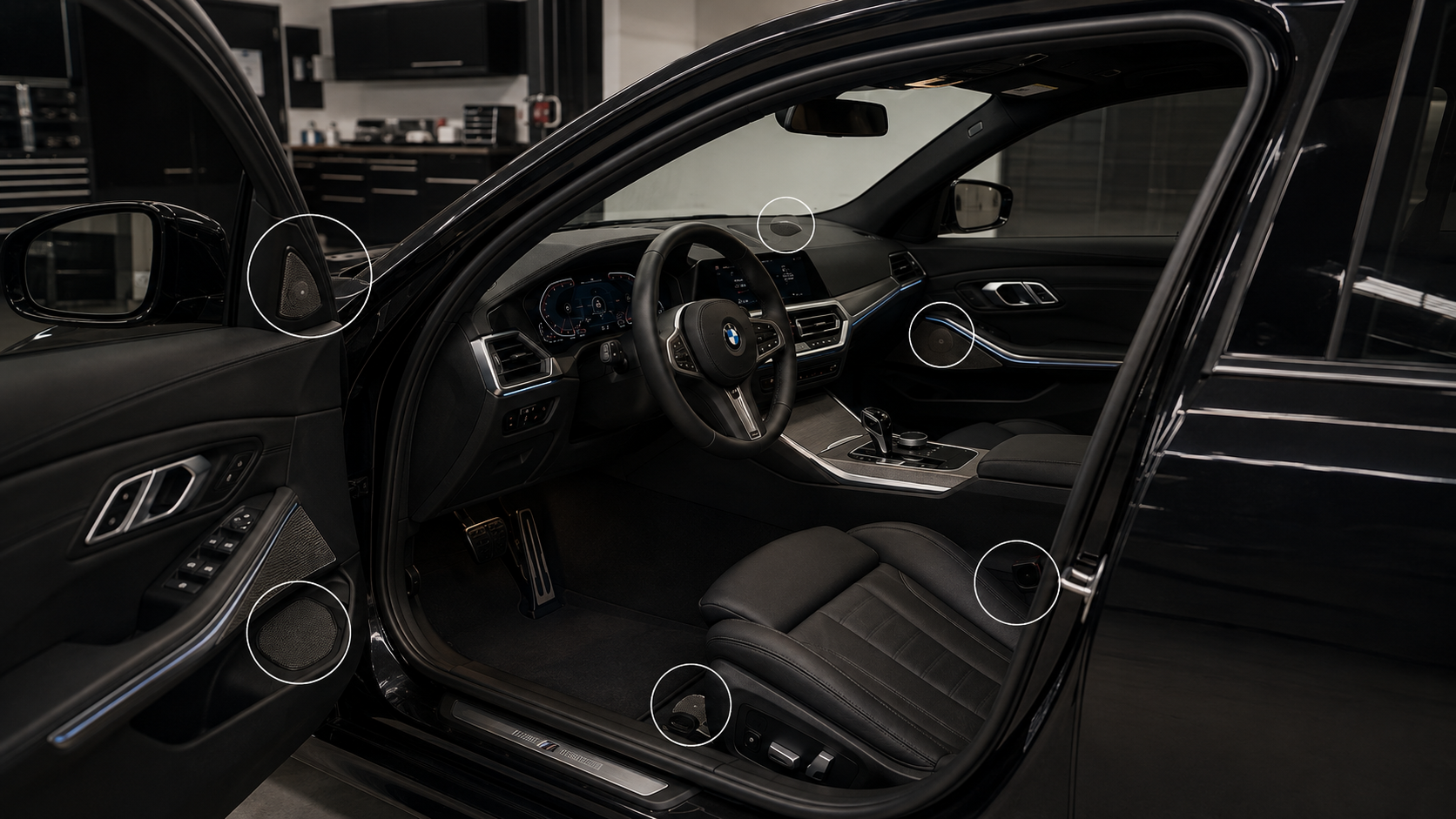
You paid extra for Harman Kardon. That doesn't mean you need to replace the entire audio system to make it sound better.
The G20 already has a purpose-built factory audio system. The smarter approach is to figure out which part is actually limiting the sound and improve that first.
For most G20 Harman Kardon owners, that starts with the speakers.
✔ TL;DR
✔ The G20 Harman Kardon system already has a dedicated amplifier and factory DSP processing.
✔ The factory speakers are the first component worth addressing if you want more clarity, detail, and control.
✔ Stage One replaces the factory drivers while keeping the factory amplifier, wiring, mounting points, and controls intact.
✔ Ghost can be added if you want deeper, stronger low-end without giving up trunk space.
✔ You don't automatically need an amplifier upgrade just because you've replaced the speakers.
✔ The goal isn't to rebuild the G20's audio system. It's to improve the parts that are holding it back.
Quick Answer
If your G20 has Harman Kardon and you want better sound without turning the car into a custom-audio project, you have several options.
For better overall clarity, detail, vocals, and midrange performance, Stage One is the logical place to start.
If the system already sounds clear but you're missing depth and impact in the low end, Ghost addresses that separately.
And if you've already improved the speakers and bass and want to push the system further, an amplifier and DSP upgrade such as Revenant Pro becomes the next step.
You don't have to do all three.
You just need to figure out what you're actually missing.
You Don't Need to Rebuild the G20's Audio System
The G20's Harman Kardon system is already built around the car.
It has a dedicated amplifier, DSP processing, multiple speaker locations, and factory controls that work together as one system.
That's important because you don't necessarily need to replace the entire system to make it better.
The better question is:
Which part of the factory system is actually holding the rest of it back?
For many G20 Harman Kardon owners, the answer starts with the speakers.
If you want a deeper look at the G20's factory configurations and what changes between Hi-Fi and Harman Kardon, the BMW G20 3 Series Speaker Upgrade Guide breaks down the system in more detail.
The key point here is simpler:
You don't need to rebuild a system that already has a good foundation.
You need to improve the part that's holding it back.
What the G20 Harman Kardon System Already Gets Right
 Before criticizing the factory system, it's worth giving it some credit.
The Harman Kardon setup was designed specifically around the G20 cabin. The amplifier, DSP, speaker locations, and factory controls are all part of one integrated system.
That means you already have:
-
Factory iDrive integration
-
Steering-wheel controls
-
Factory EQ and audio settings
-
Multiple dedicated speaker positions
-
A factory amplifier designed for the system
-
A completely integrated interior
You don't need to throw all of that away just because you're unhappy with the sound.
And the G20 cabin isn't exactly an easy environment for audio.
You have glass, hard interior surfaces, relatively compact dimensions, road noise, and a listening position that's much closer to some speakers than others.
The factory system has to work around all of that.
So the goal isn't to fight the factory architecture.
Keep what works. Improve what doesn't.
So What Should You Actually Improve?
There are three areas worth considering:
1. The speakers
Start here if you're missing clarity, detail, definition, or better overall balance.
2. The low end
Look here if your system sounds reasonably clear but doesn't have enough depth or physical impact.
3. The amplification
This becomes relevant when you've already addressed the speakers and low end and want to push the system further.
The order matters.
You don't need to change everything.
1. Start With the Speakers
A factory amplifier can be perfectly capable while the speakers connected to it remain the limiting factor.
That's an important distinction.
The amplifier sends the signal.
The speaker turns that signal into sound.
If the driver struggles to reproduce that signal cleanly, adding more processing or power isn't necessarily going to solve the problem.
That's why Stage One is the logical first step for many G20 Harman Kardon owners.
What Stage One Actually Changes
 Stage One replaces the factory speakers with BMW-specific drivers designed around the G20's factory architecture.
The installation uses the existing mounting locations and factory-style connectors. There's no need to cut the factory wiring or modify the vehicle's electronics.
If you're unfamiliar with what "plug-and-play" actually means in a BMW, the BMW Plug-and-Play Speaker Upgrade guide explains why connectors, impedance, fitment, and coding all matter.
For the G20 owner, the practical benefit is simple.
Your:
-
iDrive controls
-
steering-wheel controls
-
factory EQ
-
audio profiles
-
warning chimes
-
factory amplifier
all stay in place.
The difference happens where it matters:
At the speaker.
What You'll Actually Notice
The point of Stage One isn't simply to make the G20 louder.
It's to make the existing signal sound better.
That can mean:
-
Clearer vocals
-
More defined midrange
-
Better high-frequency detail
-
Tighter midbass
-
Better separation between instruments
-
Less harshness at higher volume
-
A more convincing soundstage
The improvement becomes particularly obvious with music that has a lot happening in the midrange.
Vocals.
Guitars.
Piano.
Snare drums.
Strings.
That's where weak drivers tend to expose themselves.
The factory system isn't suddenly doing something different.
The speakers are simply doing their job better.
💡 Bavsound Insight
A capable factory amplifier doesn't automatically mean you have capable factory speakers. The amplifier can only work with what the speakers allow it to produce. On the G20 Harman Kardon system, improving the drivers lets you get more from the electronics that are already there.
Why You Don't Automatically Need a New Amplifier
This is where BMW audio upgrades can get unnecessarily complicated.
The assumption is simple:
Better speakers need more power.
Not necessarily.
A speaker upgrade needs to be properly matched to the amplifier driving it. That's why a BMW-specific replacement can work with the factory amplifier rather than requiring you to replace the amplifier at the same time.
This is also why the upgrade sequence matters. Bavsound's Speakers First, Then Subs approach explains the reasoning behind addressing the speakers before adding more hardware.
If your goal is:
"I want my G20 Harman Kardon to sound clearer and more detailed."
You don't need to begin by replacing the amplifier.
Start with the speakers.
The factory amplifier is already doing its job.
Give it better drivers to work with.
What About the Bass?
This is where you may want to make a second change.
The G20 Harman Kardon system uses underseat woofers to handle part of the low-frequency range.
But a woofer and a dedicated subwoofer aren't the same thing.
If your complaint is:
"The system sounds clear enough, but the bass doesn't have enough weight."
That's a different problem.
You don't necessarily need to replace the main speakers again.
You need to address the low end.
That's where Ghost comes in.
2. Add More Low-End Without Adding a Trunk Subwoofer
One of the advantages of an underseat approach is that you don't have to sacrifice your trunk for a large enclosure.
 Ghost is designed around the BMW's existing underseat architecture, keeping the installation integrated with the car.
The idea is simple:
Stage One improves the speakers.
Ghost gives the low end more authority.
They're solving different problems, which is why they work well together as a staged upgrade.
And you don't have to install them at the same time.
If clarity is what you're missing, start with the speakers.
If you've already got the clarity you want and bass is the problem, Ghost may be the more targeted move.
Stage One or Ghost First?
If you're choosing only one upgrade for a G20 Harman Kardon system, I'd start with Stage One for most owners.
It affects more of what you're actually listening to.
Vocals, instruments, midrange detail, treble, imaging, and overall balance all come through the main speaker system.
If your main complaint is specifically that the bass feels weak, Ghost becomes a more compelling first step.
The important thing is not to treat every G20 owner as if they have exactly the same problem.
Upgrade the weakness you can actually hear.
3. When Does an Amplifier Upgrade Make Sense?
Once you've improved the speakers and addressed the low end, there's one more question:
What if you want to take the entire system further?
That's where amplification comes into the picture.
The important thing is that an amplifier upgrade isn't automatically required just because you've installed better speakers. It becomes worthwhile when you're looking for more power, greater control, and more sophisticated processing from the system.
For G20 owners who want to go beyond the factory amplifier, the Revenant Pro Amplifier Upgrade is the next step.
It isn't simply about making the system louder.
It's about giving the speakers more capability behind them.
What the Revenant Pro Changes
 Think about the upgrade path this way:
Stage One: Improve the speakers.
Ghost: Improve the low end.
Revenant Pro: Improve amplification and processing.
Each component has a different job.
That's why you shouldn't automatically jump to the amplifier just because it's the most powerful component in the system.
If your biggest complaint is muddy vocals or weak detail, start with the speakers.
If your biggest complaint is a lack of bass, address the low end.
If you've already addressed those areas and want more control and performance from the complete system, that's when the amplifier becomes much more interesting.
You Can Keep More of the Factory System Than You Think
One of the biggest advantages of a staged approach is that you don't have to change things that already work.
You can keep:
iDrive
Your factory interface remains part of the system.
Steering-Wheel Controls
You don't lose the controls you've already become accustomed to using.
Factory Integration
You can improve the audio without turning the car into a completely separate aftermarket installation.
Factory Speaker Locations
Stage One and Ghost are designed around the BMW's existing architecture rather than requiring you to redesign the cabin.
Your Trunk
Ghost gives you another way to improve low-end performance without installing a large traditional subwoofer enclosure in the trunk.
That's important.
Upgrade the sound. Don't make the car harder to live with.
What About Sound Deadening?
 There's another part of the equation that's easy to overlook:
The cabin itself.
Your BMW is not a listening room.
Road noise, panel vibration, and resonance can all compete with the music you're trying to hear.
If you've already improved the speakers and bass and want to take the environment itself further, Bavsound by Dynamat Sound Deadening Pack can be considered as an additional step.
But this isn't where I'd start.
Think of sound deadening as a finishing layer.
First, make the system capable of producing better sound.
Then reduce the things competing with it.
Three Ways to Approach a G20 Harman Kardon Upgrade
Not every G20 owner wants the same thing.
So there isn't one mandatory upgrade path.
If You Want Better Overall Sound
Start with Stage One.
This is the most sensible starting point if your complaints are mainly about clarity, detail, vocals, or overall definition.
If You Want More Bass
If you're already happy with the clarity of your system but want more depth and impact, Ghost is the more targeted upgrade.
If You Want to Push the Entire System Further
If you've already upgraded the speakers and low end and want more power and processing capability, that's when the Revenant Pro becomes relevant.
At that point, you're no longer simply correcting one weakness.
You're building a more capable version of the system.
The G20 Harman Kardon Upgrade Path
| What You Want | Where to Start |
|---|---|
| Better clarity | Stage One |
| Better vocals | Stage One |
| More detail | Stage One |
| Stronger midbass | Stage One |
| More low-end impact | Ghost |
| More power and control | Revenant Pro |
| A more complete system | Stage One + Ghost |
| Maximum improvement | Stage One + Ghost + Revenant Pro |
The important part is that you don't have to buy the whole table.
Start with the problem you actually have.
Frequently Asked Questions
Do I need to replace the amplifier when upgrading my G20 Harman Kardon speakers?
No.
A properly matched speaker upgrade can work with the factory amplifier. Stage One is designed around the G20's factory system, so replacing the speakers doesn't automatically mean replacing the amplifier.
Will Stage One make my G20 louder?
That's not the main goal.
The bigger improvement is in clarity, detail, definition, and overall speaker performance.
A better audio system isn't necessarily one that simply plays louder.
Should I install Ghost before Stage One?
If bass is your only complaint, Ghost can make sense as the targeted upgrade.
For most owners looking for a broader improvement, Stage One is the better place to start because it affects a much larger portion of the music you hear.
Do I need Ghost if I install Stage One?
Not necessarily.
Stage One and Ghost solve different problems.
Stage One improves the main speakers, while Ghost focuses on low-frequency output.
If you're happy with the bass after Stage One, there's no reason to add another component simply because it exists.
When should I consider the Revenant Pro?
Consider it when you've already addressed the speakers and low end and want more power, control, and DSP capability.
It's a further step rather than a prerequisite for improving the G20 HK system.
Do these upgrades change the factory look of my G20?
The upgrades are designed around the BMW's existing architecture and speaker locations, so you can improve the system without turning the interior into a visibly modified aftermarket installation.
Can I install Stage One and Ghost myself?
Both are designed as DIY-friendly upgrades, and Bavsound provides BMW-specific installation guides to walk you through the process.
The difficulty depends on your comfort level with removing interior trim and working carefully around the vehicle.
Key Takeaways
✔ You don't need to rebuild your G20 Harman Kardon's entire audio system to make it significantly better.
✔ Start by identifying what you actually want to improve.
✔ Stage One is the logical starting point for better clarity, detail, vocals, and overall speaker performance.
✔ Ghost is the targeted upgrade for owners who want more low-end impact.
✔ Revenant Pro becomes relevant when you want more power, control, and DSP capability after addressing the speakers.
✔ Sound deadening can be a finishing step when road noise and vibration are getting in the way.
✔ The biggest advantage of a staged approach is that you can improve the system without throwing away the factory integration that already works.
Ready to Find the Right Upgrade for Your G20?
Every G20 isn't configured exactly the same way, so the right combination depends on your specific vehicle and factory audio setup.
Start with Build Your Bavsound Kit to see what's available for your BMW.
If you're unsure about your configuration or which upgrade makes the most sense, Bavsound Sales & Support can help you determine the right path.
You don't have to rebuild everything.
You just have to upgrade the part that's holding the system back.
Share:
BMW M3 and M4 Speaker Upgrade: What Works, What Doesn't, and Why It Matters More in an M Car
Why Does My BMW Audio Distort at High Volume?