


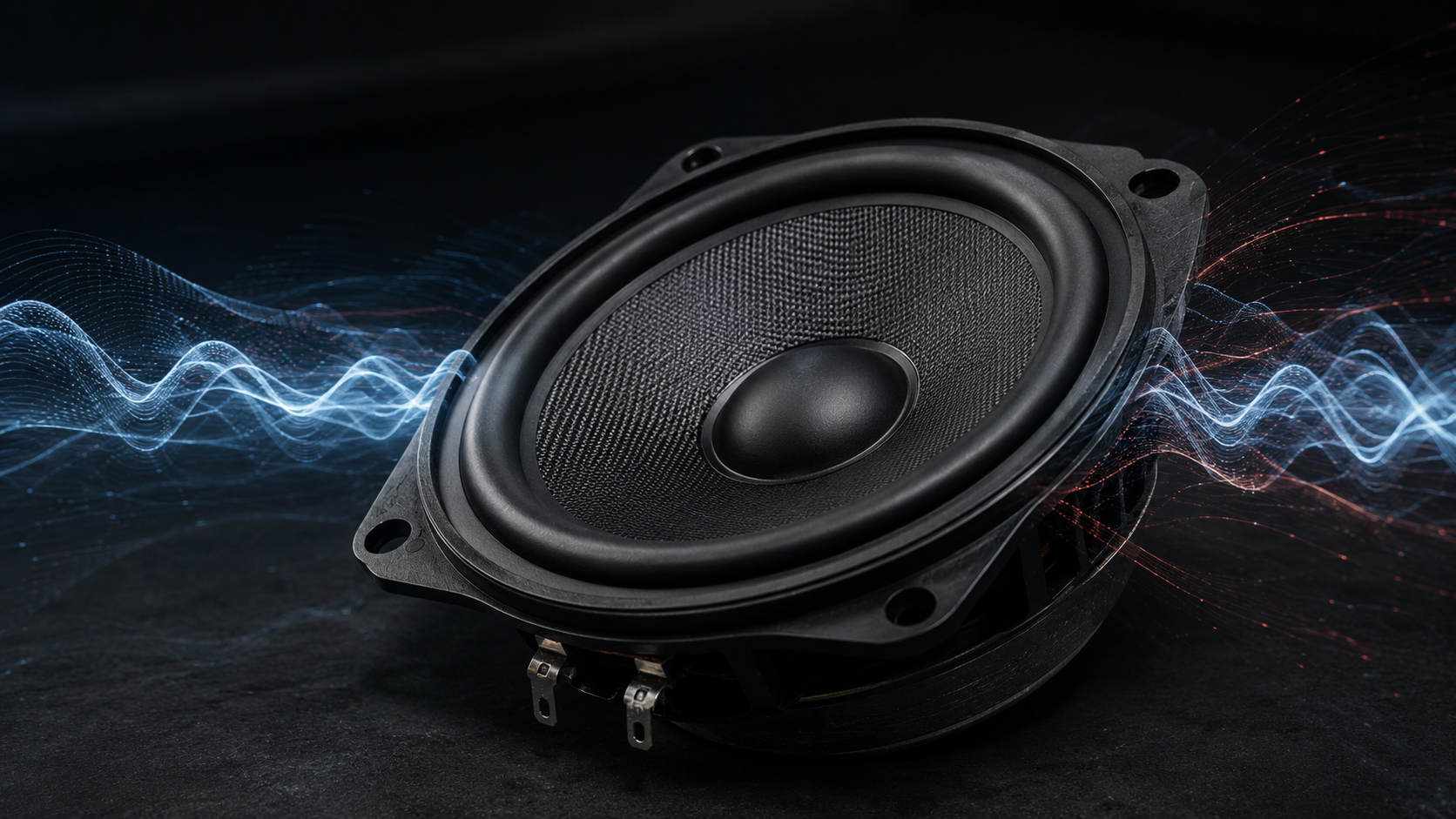
If you've ever looked at BMW speaker specifications and wondered why one speaker says 2 ohms, another says 4 ohms, and another says 8 ohms, you're looking at one of the most important specifications in a BMW audio system.
Speaker impedance affects how the speaker and amplifier work together. And when you're replacing BMW speakers, getting that match right matters far more than simply finding something that fits the factory opening.
✔ TL;DR
✔ Speaker impedance is the electrical load a speaker presents to the amplifier, measured in ohms (Ω).
✔ BMW uses different speaker impedances depending on the vehicle, factory audio system, and speaker position.
✔ The factory amplifier is designed around the impedance of the speakers it drives.
✔ Using a speaker with the wrong impedance can affect output, balance, distortion, and amplifier performance.
✔ A speaker that physically fits your BMW isn't necessarily electrically compatible.
✔ Stage One is designed around the specific electrical and physical requirements of the BMW system it replaces.
Quick Answer
Speaker impedance describes the electrical load a speaker presents to an amplifier.
In simple terms, it helps determine how much current the amplifier needs to deliver to drive that speaker.
BMW doesn't use one universal speaker impedance across every model. Different vehicles, factory audio systems, and speaker positions can use different impedance ratings.
That's why replacing a BMW speaker isn't simply a matter of finding one with the right diameter.
The speaker needs to fit the car physically and work with the amplifier electrically.
What Does "Ohms" Actually Mean?
Let's make this less painful than the average car audio forum thread.
You don't need an electrical engineering degree to understand impedance.
Think of the amplifier as the component supplying electrical energy to the speaker.
The speaker presents a load to that amplifier.
That load is described by its impedance, measured in ohms (Ω).
In simplified terms:
Lower impedance = the amplifier has to deliver more current.
Higher impedance = the amplifier delivers less current.
That relationship affects how much power the amplifier can deliver to the speaker.
For example, an amplifier designed to deliver a certain amount of power into a 2-ohm load won't behave exactly the same way when connected to a 4-ohm speaker.
The amplifier's output changes with the load.
And BMW engineers know that when they design the factory audio system.
Why Does BMW Use Different Impedances?
This is where BMW audio gets interesting.
There isn't one universal speaker specification across every BMW.
Different models, generations, factory audio systems, and speaker positions can use different impedance ratings.
You may encounter 2-ohm, 4-ohm, or 8-ohm speakers across different BMW applications.
That means there isn't one universal "BMW speaker impedance."
A 3 Series isn't automatically the same as a 5 Series.
A Harman Kardon system isn't automatically the same as a Hi-Fi system.
And even within the same vehicle, different speaker positions can have different electrical requirements.
That's why BMW model + production year + factory audio system matters when selecting replacement speakers.
Why the Factory Amplifier Cares
Your BMW's amplifier isn't just a box that makes the music louder.
It's part of a system designed around the speakers connected to it.
The amplifier is expecting a particular electrical load.
Change that load, and you change the relationship between the amplifier and speaker.
Imagine the factory system was engineered around a specific speaker impedance.
You remove that speaker and install a generic replacement because it has the right diameter and mounting adapter.
Physically, it fits.
Electrically, it may not.
And that's where things can get interesting.
The new speaker may draw more or less current than the amplifier was designed around. The result can be a change in output, system balance, distortion characteristics, or amplifier stress.
The speaker may even sound perfectly fine at low volume.
Then you turn the music up.
That's when the mismatch can become much more obvious.
💡 Bavsound Insight
A speaker can be the right size and still be the wrong speaker for your BMW. Physical fitment gets it into the door. Electrical compatibility determines whether the factory amplifier can drive it the way it was designed to.
What Happens If You Install the Wrong Impedance?
This is the part BMW owners should actually care about.
Let's say your factory amplifier is designed to work with a particular impedance, but you install a speaker with a significantly different load.
Several things can happen.
The Output Can Change
The amplifier's power delivery depends on the load it's driving.
A different impedance can therefore change how loudly that speaker plays relative to the rest of the system.
The System Can Become Unbalanced
BMW's factory audio system is tuned as a complete system.
If one speaker position suddenly behaves differently from the others, the tonal balance can change.
You might end up with one part of the system playing louder or quieter than it should.
Distortion Can Appear at Higher Volume
An impedance mismatch can make an amplifier work outside the conditions it was designed around.
At moderate volume, you may not notice anything.
Turn it up, and distortion or compression can become much more apparent.
The Amplifier Can Be Put Under Additional Stress
A lower impedance load can demand more current from an amplifier.
If the amplifier isn't designed to handle that load, you're asking it to work harder than intended.
That doesn't mean every impedance difference will immediately destroy an amplifier.
It means there's no good reason to introduce an electrical mismatch when you're trying to improve a factory system.
Why "It Fits" Isn't Enough
This is one of the biggest mistakes people make when shopping for BMW speakers.
They measure the factory speaker.
They find an aftermarket speaker with a similar diameter.
They buy an adapter bracket.
It bolts in.
Problem solved.
Except it isn't.
BMW speaker fitment involves much more than diameter.
You also have:
-
Mounting depth
-
Basket shape
-
Mounting points
-
Connector type
-
Impedance
-
Efficiency
-
Frequency response
-
The acoustic characteristics of the factory speaker location
The BMW Speaker Size Guide goes into the physical side of this in much greater detail.
Impedance is simply the electrical piece of the same puzzle.
A proper BMW speaker replacement has to fit physically and electrically.
Why Generic 4-Ohm Speakers Aren't Automatically the Answer
This is where generic car audio advice can get misleading.
If you've searched for aftermarket speakers before, you've probably noticed that 4-ohm speakers are everywhere.
That doesn't make 4 ohms the correct choice for every BMW.
The right impedance depends on what your specific factory amplifier and speaker position were designed around.
The BMW Plug-and-Play Speaker Upgrade Guide explains why BMW speaker replacement involves more than finding something that physically fits. Connectors, dimensions, impedance, and the factory electronics all have to work together.
That's why "this is a 4-ohm speaker and 4 ohms is standard" isn't enough information to make a good buying decision.
Standard isn't the same thing as correct.
How Bavsound Handles Impedance
This is where a BMW-specific speaker upgrade takes a different approach from a generic aftermarket speaker.
Rather than starting with a standard aftermarket speaker and figuring out how to adapt it to the BMW, Bavsound starts with the factory application.
The replacement speaker is engineered around the specific BMW system it's intended to replace.
That includes the:
-
Impedance
-
Mounting dimensions
-
Connector
-
Speaker position
-
Electrical characteristics
-
Factory amplifier
That's what allows Stage One to operate within the factory audio architecture instead of requiring you to redesign the system around the new speakers.
The objective isn't simply:
"Will this speaker fit?"
It's:
"Will this speaker work correctly with this BMW?"
That's a much better question.
Why Impedance Matters More in a BMW
BMW owners aren't usually replacing speakers in a completely independent audio system.
They're working within a factory system where the amplifier, speakers, wiring, DSP, and acoustic environment were designed to work together.
That's why impedance isn't just a number on a specification sheet.
It's part of the relationship between the amplifier and the speaker.
And once you understand that, a lot of BMW audio upgrade decisions become much easier.
You stop asking:
"What speaker fits my BMW?"
And start asking:
"What speaker is actually designed to work with my BMW?"
That's the difference between installing something that happens to fit and upgrading the system properly.
How to Choose the Right Impedance for Your BMW
Once you understand what impedance means, the next question is the one that actually matters when you're shopping for speakers:
What impedance should you use in your BMW?
The answer isn't simply "2 ohms" or "4 ohms."
It depends on the BMW, the factory audio system, the speaker position, and the amplifier driving that speaker.
That's why there isn't a single impedance rating that is right for every BMW.
Don't Choose a Speaker by Impedance Alone
Impedance matters, but it's only one part of the equation.
A replacement speaker also needs to work with the rest of the system.
That means considering:
-
Impedance
-
Speaker sensitivity
-
Power handling
-
Frequency response
-
Physical dimensions
-
Mounting depth
-
Connector type
-
Speaker location
-
Factory amplifier characteristics
A speaker could have the correct impedance and still be a poor choice for your BMW.
It might fit physically but have the wrong sensitivity.
It might have the right impedance but require different wiring.
It might bolt into the door but perform poorly in the acoustic environment it was never designed for.
Matching one specification isn't the same as matching the entire system.
What About 2-Ohm vs 4-Ohm Speakers?
This is probably the most common impedance question.
A lower-impedance speaker generally allows an amplifier to deliver more current and potentially more power.
A higher-impedance speaker generally draws less current.
But more power isn't automatically better.
If the amplifier was designed around a particular load, changing that load can alter the way the system behaves.
For example, installing a lower-impedance speaker than the factory system expects can increase the electrical demand on the amplifier.
That might sound attractive if you're thinking:
"More power must mean more volume."
But the amplifier has to be designed to handle that load.
Otherwise, you're not upgrading the system.
You're asking the amplifier to do something it wasn't designed to do.
What If the Impedance Is Higher?
Going in the other direction creates a different problem.
A higher-impedance speaker generally draws less current from the amplifier.
That can mean less power reaches the speaker.
The speaker may still work.
It may even sound perfectly acceptable.
But you could end up with lower output than the factory speaker or an imbalance between different parts of the system.
Again, the issue isn't that 4 ohms is inherently better than 2 ohms, or vice versa.
The correct impedance is the one that works with the amplifier and system it was designed for.
Why BMW-Specific Speakers Make This Easier
This is one of the reasons a BMW-specific upgrade is different from buying a generic speaker off the shelf.
With a universal speaker, you're starting with a component and trying to make it work with the car.
With a BMW-specific speaker, the car is the starting point.
The speaker can be designed around the factory amplifier, connector, mounting location, and electrical requirements.
That's the philosophy behind Stage One.
You don't need to calculate the correct impedance yourself and then try to find a speaker that happens to match.
The replacement is engineered around the application.
That's especially important when BMW has used different impedance ratings across different models and audio configurations.
Does Impedance Affect Sound Quality?
Indirectly, yes.
Impedance itself isn't a measure of sound quality.
A 2-ohm speaker isn't automatically better than a 4-ohm speaker.
A 4-ohm speaker isn't automatically more accurate than a 2-ohm speaker.
What matters is how the speaker behaves when connected to the amplifier driving it.
If the electrical relationship is wrong, you can end up with:
-
Reduced output
-
Uneven volume between speakers
-
Changes in tonal balance
-
Increased distortion
-
Poor amplifier performance
A properly matched speaker can make better use of the amplifier's available output.
So when you're evaluating BMW speaker upgrades, don't ask:
"Which impedance sounds best?"
Ask:
"Which impedance was this system designed to use?"
That's the useful question.
Does Impedance Change With Frequency?
Here's where the word impedance gets slightly more complicated.
A speaker isn't a simple resistor.
Its impedance can change depending on the frequency being reproduced.
A speaker might be described as having a nominal impedance of 2 or 4 ohms, but its actual electrical impedance can move above and below that value across its frequency range.
That's because a speaker contains moving mechanical components and electrical elements that respond differently at different frequencies.
So when you see:
4 Ω
on a speaker specification, don't interpret it as:
"This speaker has exactly 4 ohms of resistance at every moment."
It's a nominal rating used to describe how the speaker behaves as an electrical load.
That distinction matters when you're comparing speakers designed for different applications.
Why Sensitivity Matters Alongside Impedance
Here's another specification that's easy to overlook.
Two speakers can have the same impedance and still produce very different output from the same amplifier.
That's where sensitivity comes in.
Sensitivity describes how efficiently a speaker converts the amplifier's electrical power into acoustic output.
Imagine two speakers:
Speaker A: 4 ohms, high sensitivity
Speaker B: 4 ohms, lower sensitivity
Both present the same nominal load to the amplifier.
But they won't necessarily produce the same volume from the same amount of power.
This is particularly important in BMWs because the factory amplifier is already part of the vehicle's design.
You don't necessarily have unlimited power available.
A well-designed replacement speaker therefore needs to work with the amplifier, not simply demand more from it.
The BMW Audio System Is a Complete Electrical System
This is the bigger picture.
Your BMW's audio system isn't just:
Amplifier → Speaker
It's closer to:
Source → Signal Processing → Amplifier → Wiring → Speaker → Cabin
Every part has a role.
Change one component and you need to consider how it interacts with everything around it.
That's why replacing BMW speakers isn't simply about finding something with the right diameter and impedance.
The best replacement is one that works within the entire system.
💡 Bavsound Insight
The goal of a BMW speaker upgrade isn't to make the speaker demand more from the factory amplifier. It's to make better use of what the factory system is already capable of delivering.
Can You Damage a BMW Amplifier With the Wrong Speaker?
Potentially, depending on the mismatch and the amplifier's design.
A significantly lower impedance can demand more current than the amplifier was designed to supply.
That can increase heat and electrical stress.
Modern amplifiers have protection circuitry, so an impedance mismatch doesn't necessarily mean immediate failure.
But protection circuitry isn't a reason to deliberately use the wrong speaker.
If you're upgrading a BMW, there is very little upside to experimenting with an impedance that isn't appropriate for the factory system.
Match the speaker to the amplifier and move on to the part that actually improves the sound.
What Should You Check Before Buying BMW Speakers?
Before buying a replacement speaker, check these six things:
1. Your BMW model
A G20 3 Series doesn't necessarily use the same speakers as a G30 5 Series.
2. Production year
BMW can change components during a model generation.
3. Factory audio system
Base Audio, Hi-Fi, Harman Kardon, and other factory configurations can use different components.
4. Speaker position
A door midrange, tweeter, and underseat woofer don't necessarily use the same specifications.
5. Impedance
Make sure the replacement is electrically compatible with the factory amplifier.
6. Physical fitment
The speaker still needs to fit the mounting location, connector, and available space.
If you want to check the physical side of BMW speaker fitment, the BMW Speaker Size Guide or simply use Build Your Bavsound Kit
The Simple Rule for BMW Speaker Impedance
You don't need to memorize every impedance rating BMW has ever used.
You just need to remember one rule:
Don't choose the impedance first. Choose the speaker that's designed for your BMW.
Once the speaker is properly matched to the factory amplifier and physical installation, the impedance is no longer something you need to guess at.
That's the advantage of a vehicle-specific solution.
Frequently Asked Questions
Is 2 ohms better than 4 ohms for BMW speakers?
No.
Neither is inherently better. The correct impedance depends on the BMW's factory amplifier and the specific speaker application.
Can I use any 4-ohm speaker in my BMW?
Not necessarily.
Impedance is only one part of compatibility. The speaker also needs to match the amplifier, physical dimensions, connector, sensitivity, and intended speaker location.
Will a lower-ohm speaker make my BMW louder?
It can change how much power the amplifier delivers, but that doesn't automatically mean better or cleaner sound.
If the amplifier isn't designed for the lower load, you can create additional electrical stress.
Why don't all BMW speakers use the same impedance?
BMW uses different amplifier and speaker configurations across different models, generations, and factory audio systems.
The electrical requirements can therefore vary by application.
Does impedance affect bass?
It can affect how much power reaches a speaker, which can influence output. But bass performance also depends on the speaker's design, enclosure, excursion, sensitivity, and the amplifier driving it.
Impedance alone doesn't determine how much bass a speaker produces.
Do I need to know my BMW's exact impedance before buying Bavsound?
You don't need to calculate it yourself.
The important thing is to identify your BMW's exact model, production year, and factory audio configuration so you can select the correct application.
The Build Your Bavsound Kit can help you identify the appropriate upgrade for your vehicle.
 Key Takeaways
✔ Speaker impedance describes the electrical load a speaker presents to an amplifier.
✔ Lower impedance generally means the amplifier has to deliver more current.
✔ Higher impedance generally means the amplifier delivers less current.
✔ BMW uses different impedance ratings across different models, audio systems, and speaker positions.
✔ The correct impedance isn't necessarily the lowest or highest one. It's the one the system was designed around.
✔ Physical fitment alone doesn't make a speaker compatible.
✔ Sensitivity, power handling, connectors, mounting, and impedance all need to work together.
✔ A BMW-specific speaker upgrade takes these factors into account rather than asking you to figure them out individually.
Ready to Find the Right Speakers for Your BMW?
The easiest way to avoid guessing is to start with your exact vehicle and factory audio system.
Use Build Your Bavsound Kit to see the compatible upgrades for your BMW.
Because when it comes to speaker impedance, the answer isn't "2 ohms is better" or "4 ohms is better."
It's much simpler:
The right impedance is the one your BMW was designed to use.
Share:
BMW X1 and X2 Speaker Upgrade: The Complete Guide for F48, F39, and U11 Owners