


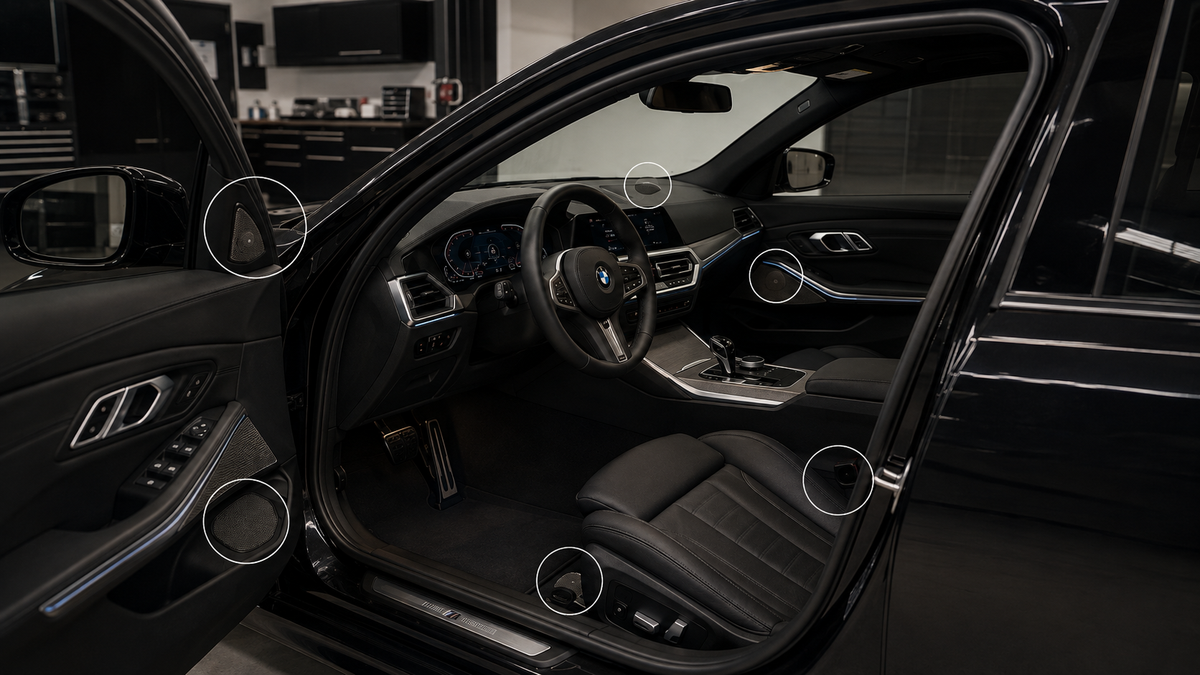
You can install better speakers in your BMW and still hear things you don't want to hear.
A door panel rattling with the bass. A little resonance around the speaker. Road noise masking details that weren't a problem when the car was sitting still.
That raises a useful question: does sound deadening actually make your BMW speakers sound better, or does it just make the car quieter?
✔ TL;DR
✔ Yes. Sound deadening can make your BMW's audio sound cleaner by reducing unwanted panel vibration, resonance, and rattles.
✔ It can be particularly useful around speaker mounting areas and panels that vibrate when the system is playing.
✔ Sound deadening does not make the factory speakers equivalent to an upgraded speaker system.
✔ It does not add amplifier power or create more bass output.
✔ If your BMW lacks clarity and detail, Bavsound Stage One addresses the speakers themselves.
✔ If your main complaint is weak or uncontrolled low end, Bavsound Ghost addresses the underseat woofers.
✔ Sound deadening is often most useful as a finishing step after addressing the parts of the audio system that are actually limiting your sound.
Quick Answer
Yes, sound deadening can make your BMW's speakers sound better, but indirectly.
It doesn't make the speaker itself more powerful or more detailed. Instead, it changes the environment the speaker is working in.
When a speaker moves air, some of that energy can also make nearby panels vibrate. Those vibrations can create unwanted resonance, rattles, and noise that compete with the music.
Reducing those vibrations can make the sound feel cleaner, tighter, and more controlled.
Think of it this way:
Better speakers improve the source.
Better subwoofers improve the low end.
Sound deadening improves the environment those components are working in.
What Does Sound Deadening Actually Do?
A BMW door isn't designed to be a perfect acoustic enclosure.
It's a large piece of metal surrounded by trim, clips, wiring, glass, and other components. When the speaker moves, some of that energy can travel into the surrounding structure.
That can produce vibration and resonance.
Sound-deadening material helps reduce that unwanted movement by adding damping to the panel.
The result isn't necessarily a dramatic increase in volume.
Instead, you're trying to reduce the things that shouldn't be making sound in the first place.
That can mean:
✔ Less panel vibration
✔ Fewer rattles
✔ Less unwanted resonance
✔ Cleaner midbass
✔ A more controlled presentation
And sometimes, simply reducing those distractions makes the music easier to hear.
Can Sound Deadening Make Your BMW Speakers Sound Clearer?
It can.
Imagine you're listening to a song with a strong kick drum and bass guitar.
The speaker is doing its job, but the surrounding door panel is vibrating along with it. That vibration can add unwanted energy to the sound.
Now imagine reducing that vibration.
The speaker hasn't suddenly become a different speaker. But the surrouing environment is no longer contributing as much unwanted noise.
That's why sound deadening can make the system feel cleaner without actually increasing the speaker's output.
This is particularly relevant to midbass and midrange, where panel vibration and resonance can become noticeable.
What Sound Deadening Does NOT Fix
This is where expectations matter.
Sound deadening is useful, but it isn't an audio-system upgrade by itself.
If your factory speakers sound dull, muddy, thin, or lacking in detail, putting material on the surrounding panels won't turn those speakers into high-performance replacements.
That's a speaker problem.
If you're looking for more clarity and detail from the speakers themselves, Bavsound Stage One is designed to replace the factory speakers while working with the BMW's existing audio system.
Likewise, sound deadening won't suddenly give your BMW deeper sub-bass.
If the system's low end is the limitation, Bavsound Ghost addresses the compatible factory underseat woofers instead.
So the distinction is important:
| What you're missing | What addresses it |
|---|---|
| Clarity and detail | Stage One |
| Better speaker performance | Stage One |
| Deeper, stronger low end | Ghost |
| Panel vibration and resonance | Sound deadening |
| More amplifier power | Amplification |
Sound deadening has a job. It just isn't every job.
Where Does Sound Deadening Make the Most Sense?

If you're using sound deadening to improve your BMW's audio environment, speaker and panel areas are the logical places to start.
The front doors are particularly relevant because they contain large panels surrounding speakers and can be affected by vibration.
Treating the areas around the speaker and other panels that are prone to resonance can help create a more controlled environment for the speaker to operate in.
That doesn't mean you need to cover every square inch of the BMW.
More material isn't automatically better.
The goal is to address the surfaces where vibration and resonance are actually affecting the listening experience.
Should You Add Sound Deadening Before Upgrading Your BMW Speakers?
Usually, it makes more sense to address the biggest limitation first.
If the factory speakers are the obvious weak point, start there.
Bavsound Stage One is designed to replace the factory speakers with BMW-specific components while keeping the factory audio architecture intact.
If you've already improved the speakers and low end, sound deadening can then make sense as another layer of refinement.
This is especially useful if you're noticing:
-
Door-panel vibration
-
Rattles when bass hits
-
Resonance around the speaker
-
Road noise masking detail
-
A system that sounds good but could feel more controlled
The important thing is to fix the problem you're actually hearing.
Can Sound Deadening Improve Bass?
It can improve the way bass is perceived, but it doesn't create additional bass output.
That's an important distinction.
If a door panel vibrates every time a bass note hits, some of what you're hearing is the panel rather than the speaker reproducing the music cleanly.
Reducing that vibration can make the bass feel more controlled.
But if your BMW simply doesn't produce enough low-frequency output, sound deadening isn't going to solve that.
That's where an actual subwoofer upgrade becomes relevant.
For compatible BMWs, Bavsound Ghost is designed to improve the low-frequency performance of the factory underseat woofer locations.
So:
Sound deadening can clean up the bass you already have.
Ghost is designed to improve the bass itself.
Those are two very different things.
Is Sound Deadening Necessary for a BMW Audio Upgrade?
No.
You don't need to add sound deadening simply because you've upgraded your BMW's speakers.
If your system sounds clean, there are no significant rattles, and you're happy with the acoustic environment, there may not be much reason to add it.
It's better thought of as an optional refinement rather than a mandatory part of every audio upgrade.
For many BMW owners, the more logical progression is:
1. Address the speakers if clarity is the problem.
2. Address the underseat woofers if low end is the problem.
3. Address vibration and resonance if the environment is getting in the way.
That keeps the upgrade focused instead of turning a simple audio improvement into a full car disassembly project. Humanity has survived without removing every door panel at once, and we'd like to keep it that way.
💡 Bavsound Insight
Sound deadening works best when you treat it as a refinement, not a replacement for better audio components. If the speakers are limiting your system, upgrade the speakers. If the low end is the limitation, address the woofers. Once those parts are doing their job, reducing vibration and resonance can help the whole system sound more controlled.

Does Sound Deadening Make a BMW Quieter?
It can reduce certain types of vibration and unwanted noise, but sound deadening and soundproofing aren't exactly the same thing.
The goal in an audio installation is often less about making the entire cabin silent and more about reducing unwanted panel movement and resonance around the audio system.
That distinction matters because road noise, wind noise, tire noise, and structural vibration all have different causes and require different approaches.
For audio purposes, you're mainly trying to make the car a better environment for the speakers to work in.
Is Bavsound Sound Deadening Worth Adding?
If you've already addressed the main limitations of your BMW's audio system and you're looking for another layer of refinement, Bavsound by Dynamat Extreme Sound Deadening is designed specifically for this type of application.
It's particularly relevant when you're dealing with panel vibration, resonance, or rattles around areas where your upgraded audio system is working hard.
The key is to use it where it can actually help rather than treating the entire vehicle simply because more material sounds like more improvement.
FAQ
Does sound deadening improve BMW speaker quality?
It can improve the perceived quality of the system by reducing panel vibration, resonance, and rattles. It does not change the underlying performance of the speaker itself.
Does sound deadening make BMW bass better?
It can make existing bass sound tighter and more controlled by reducing unwanted vibration. It does not create additional low-frequency output.
Should I install sound deadening before Stage One?
Not necessarily. If your factory speakers are the main limitation, upgrading the speakers first directly addresses that problem. Sound deadening can then be added as a refinement if vibration or resonance remains noticeable.
Does sound deadening help with door rattles?
Yes. Reducing panel vibration can help reduce unwanted rattles, although the exact cause of a rattle should be identified before deciding what treatment it needs.
Do I need sound deadening with Bavsound Stage One?
No. Stage One does not require sound deadening to function. It can be added if you want to further address panel vibration or resonance.
Does sound deadening replace a subwoofer upgrade?
No. Sound deadening and a subwoofer upgrade solve different problems. If your BMW needs more low-frequency output, a compatible Ghost Underseat Subwoofer upgrade is designed for that purpose.
Where should I install sound deadening in my BMW?
For audio applications, speaker and surrounding panel areas are logical places to focus, particularly where you notice vibration or resonance. Always follow the installation instructions for the specific vehicle and product.
Key Takeaways
✔ Sound deadening can make your BMW's audio sound cleaner by reducing unwanted vibration and resonance.
✔ It improves the environment around the speaker rather than changing the speaker itself.
✔ It can help reduce rattles and make midbass and midrange feel more controlled.
✔ It does not increase amplifier power or create additional bass output.
✔ If clarity and detail are the problem, Stage One addresses the speakers.
✔ If deeper and stronger low end is the problem, Ghost addresses the underseat woofers.
✔ Sound deadening is often best treated as a refinement after the major limitations of the audio system have been addressed.
✔ You don't need to add sound deadening simply because you've upgraded your BMW's audio system.
Ready to Find the Right Upgrade?
Use the Build Your Kit tool or email support@bavsound.com with your VIN and we will walk you through the right combination.
Share:
Can Stage One and Ghost Work With the Factory BMW Amplifier?