


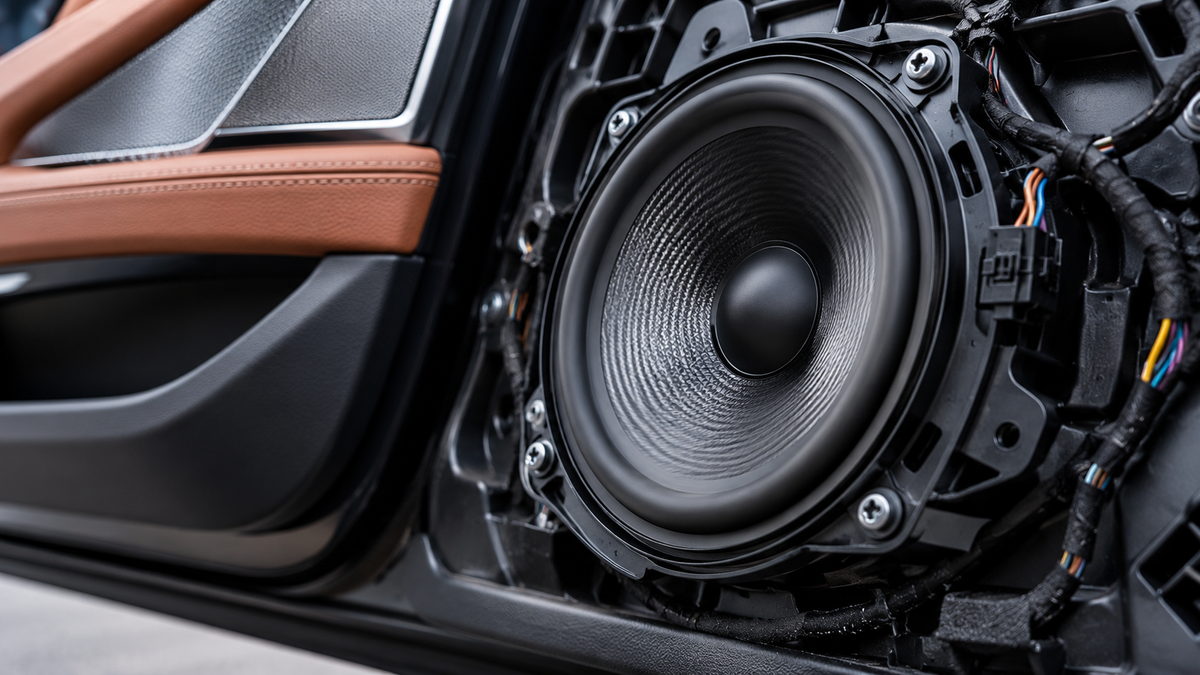
One side of your BMW sounds louder than the other, and suddenly you're sitting in the driver's seat wondering whether BMW deliberately installed a stereo with a personality disorder.
Usually, there's a reason.
A left-right imbalance can come from something as simple as the balance setting or your listening position. It can also point to a weak speaker, wiring issue, source problem, or amplifier channel issue.
The important thing is not to start replacing parts before figuring out where the imbalance is coming from.
✔ TL;DR
✔ Check your BMW's balance and fader settings first.
✔ Test more than one song or audio source before assuming something is wrong with the car.
✔ If the imbalance follows one specific speaker, that speaker or its wiring may be the problem.
✔ If the imbalance changes with the audio source, the recording, streaming service, or connection may be responsible.
✔ If the entire left or right side is consistently quieter, the problem may be farther upstream in the wiring, amplifier, or signal path.
✔ If the speakers are worn, damaged, or simply struggling to reproduce clean sound, a BMW-specific speaker upgrade such as Bavsound Stage One can address the speaker side of the problem.
✔ If both sides are balanced but the system still feels weak in the low end, that's a different problem. Bavsound Ghost is designed specifically to improve bass from compatible BMW underseat woofer locations.
✔ Because BMW audio configurations vary by vehicle, always verify compatibility before ordering.
Quick Answer
If one side of your BMW sounds louder than the other, start by checking the balance and fader settings, then test another song and another audio source.
If the same side remains quieter regardless of what you're playing, start looking at the hardware.
A single weak speaker can make one part of the soundstage seem quieter. A wiring or connector problem can affect an individual speaker or group of speakers. An amplifier or signal-path problem can affect an entire side.
The easiest way to diagnose it is to work from the simplest possibilities to the more complicated ones.
1. Check the Balance and Fader Settings
This sounds almost insultingly obvious.
Check it anyway.
Your BMW's audio settings allow you to shift the sound toward the left, right, front, or rear. If the balance has been moved accidentally, one side can sound noticeably louder even though every component is working perfectly.
Set the balance to the center.
Set the fader to the center.
Then listen again.
If the imbalance disappears, congratulations. Your expensive diagnostic equipment was the touchscreen you were already staring at.
If it remains, keep going.
2. Test With a Different Song
Before touching anything in the car, change the recording.
Some recordings have uneven stereo mixes. Certain instruments may sit noticeably farther to one side, and older recordings can be particularly obvious about it.
Play a few tracks that you know well.
Ideally, use recordings with vocals or instruments centered in the stereo image.
If one side sounds quieter across multiple recordings, that's much more useful information than noticing the problem on a single song.
A useful test
Play the same song at a moderate volume and listen for a centered vocal.
If the vocal consistently appears to come from one side rather than sitting between the speakers, you've established that the issue probably isn't just one unusual recording.
3. Try a Different Audio Source
The same principle applies to the source itself.
If you're normally listening through Bluetooth, try another source available in your BMW.
You can also try:
-
Another streaming service
-
A different phone
-
Another connection method
-
A locally stored track
-
FM or another available factory source
If the imbalance disappears when you change sources, the car's speakers may not be the problem at all.
If it stays exactly the same, the vehicle becomes much more interesting as a suspect.
Unfortunately, cars are excellent at making simple problems into detective stories.
4. Pay Attention to Whether It's One Speaker or an Entire Side
This is one of the most useful distinctions you can make.
A BMW has multiple speakers contributing to what you hear. If one specific speaker is weak, you may notice that a particular part of the music has disappeared rather than simply hearing the entire left or right side become quieter.
For example:
-
Vocals sound weak, but bass seems normal.
-
High frequencies seem quieter on one side.
-
One door sounds noticeably less present.
-
One speaker rattles or crackles.
-
The entire left side sounds quieter than the right.
These clues help narrow down the problem.
If one speaker is affected
The speaker itself, its connector, or its local wiring becomes more likely.
If several speakers on the same side are affected
The problem may be farther upstream, such as wiring, a connector, amplifier output, or signal processing.
That's an important difference because replacing one speaker won't fix a problem occurring somewhere else in the system.
5. Listen for Distortion, Not Just Volume
Sometimes what sounds like a volume imbalance is actually a quality imbalance.
One speaker may technically be producing sound at a similar level, but if it's distorted, rattling, or losing detail, your ear can interpret it as weaker.
Pay attention to whether the quieter side also sounds:
-
Muffled
-
Harsh
-
Crackly
-
Thin
-
Rattly
-
Less detailed
-
Less controlled at higher volume
If the problem becomes much more obvious as you turn the volume up, that's another useful clue.
A speaker that's struggling under higher output can make the imbalance more noticeable.
For more on that specific symptom, see Why Does My BMW Audio Distort at High Volume?.
6. Check Whether the Problem Changes With Volume
Turn the volume up gradually.
Don't immediately go from polite background music to testing the structural integrity of your door panels.
Listen to what happens.
If the imbalance is present at every volume
A speaker, wiring, connector, or signal-path problem becomes more likely.
If the imbalance only appears at higher volume
A speaker may be struggling to reproduce the signal cleanly, or another part of the system may be reaching its limits.
If the imbalance actually changes sides or character
That's a stronger reason to investigate the source, connection, or amplifier rather than immediately replacing speakers.
The pattern matters as much as the symptom.
7. An Aging or Damaged Speaker Can Cause an Imbalance
Factory speakers don't live in a laboratory.
They're exposed to heat, cold, vibration, humidity, and years of use. Over time, a speaker can lose some of its ability to reproduce the signal cleanly.
A damaged speaker may not stop working completely.
Instead, it may simply sound different from the speaker on the other side.
You might hear:
-
Less midrange
-
Weaker vocals
-
Less treble
-
Reduced midbass
-
Rattling
-
Crackling
-
Distortion at higher volume
That can create the impression that one side of the BMW is quieter when the real problem is that one speaker is no longer reproducing the same information properly.
8. The Connector or Wiring Could Be the Problem
If a speaker itself appears healthy, the next place to look is the connection between the speaker and the rest of the system.
A loose, damaged, or improperly seated connector can affect the signal reaching a speaker.
This becomes particularly relevant if the imbalance appeared after:
-
A speaker installation
-
Interior trim work
-
Door-panel removal
-
An audio upgrade
-
Other electrical work
If the system was balanced before something was removed or installed and became unbalanced immediately afterward, don't assume the factory system suddenly developed a philosophical objection to stereo imaging.
Check the work first.
If you've recently installed an upgrade, the Bavsound installation tutorials are the right place to verify the installation for your vehicle and product.
9. Your Amplifier Could Be Involved
If multiple speakers on one side are consistently quieter, the amplifier or signal path becomes more relevant.
The amplifier doesn't simply make the music louder. It provides the electrical signal that drives the speakers.
If one output channel or section of the signal path isn't behaving correctly, multiple speakers can be affected.
This is why it's useful to determine how many speakers are actually involved before buying replacement parts.
If the entire left side is quieter, replacing a single left speaker may not solve anything.
If one speaker alone is affected, the diagnosis points somewhere very different.
How to Tell Where the Problem Is Coming From
You don't need a full audio lab in your garage to establish some useful clues.
| What you hear | What to investigate first |
|---|---|
| Balance setting is off | Audio settings |
| Only one recording sounds uneven | Recording/source |
| Different sources sound normal | Original source or connection |
| One speaker sounds weak | Speaker or local connection |
| One speaker rattles or crackles | Speaker |
| Several speakers on one side are quieter | Wiring, signal path, amplifier |
| Problem appeared after installation | Installation/connectors |
| Imbalance gets worse at high volume | Speaker or system output limitation |
This isn't a substitute for a proper diagnosis, but it gives you a much better starting point than replacing parts at random.
What If the Factory Speakers Are Actually the Problem?
If you've tested the settings, sources, and obvious connections and the imbalance consistently follows a particular speaker, replacing that speaker may be the sensible solution.
That's where Bavsound Stage One becomes relevant.
Stage One is designed around the BMW's factory speaker locations and electrical requirements, allowing the speakers to work with the factory audio system rather than requiring an entirely new system. Bavsound's current information specifies matching the vehicle's speaker size, shape, connectors, impedance, and efficiency for the intended application.
The goal isn't simply to make one side louder.
It's to replace the weak link with a speaker designed for the BMW application and restore a more consistent, controlled sound across the system.
And if you're replacing speakers, don't guess based on physical size alone. BMW audio systems vary by vehicle and factory configuration.
Build Your Kit lets you select the BMW and configuration before choosing the appropriate upgrade.
What If the Speakers Sound Balanced but the Bass Doesn't?
That's a different problem.
If the left and right sides are balanced but the system still feels thin, you probably aren't dealing with a stereo imbalance.
You may simply be missing low-frequency output.
That's where Bavsound Ghost comes into the picture.
Ghost is designed to replace compatible BMW underseat woofers and improve bass response, including tighter and more controlled low-end performance. It is a targeted upgrade for the bass portion of the system rather than a solution to a left-right speaker imbalance.
So the distinction is simple:
One side is quieter: diagnose the imbalance.
Both sides are balanced but bass is weak: investigate the low end.
Don't use a subwoofer to solve a speaker problem. Humanity has invented enough expensive ways to fix the wrong thing.
💡 Bavsound Insight
The best audio upgrade isn't necessarily the biggest one. It's the one that addresses the part of the system you can actually hear is falling short.
When Should You Stop Troubleshooting Yourself?
If you've checked the balance and fader, tried multiple recordings and sources, and confirmed that the same side remains consistently quieter, it's reasonable to stop guessing.
Especially if the problem involves:
-
Multiple speakers
-
Wiring or connectors
-
An amplifier channel
-
A recently installed audio upgrade
-
An intermittent fault
-
A problem you can't reproduce consistently
Bavsound's Sales & Support resources can help with product, installation, and technical questions.
If you're considering an upgrade at the same time, use your BMW's exact vehicle and audio configuration rather than assuming that another BMW with the same model name uses the same speakers. Bavsound specifically recommends using the vehicle-selection system to choose the intended kit.
FAQ
Why is my BMW speaker louder on one side?
The most common things to check are the balance setting, audio source, individual speaker condition, connectors, wiring, and amplifier output. If the same side remains quieter across different sources and recordings, investigate the hardware.
Why does my BMW sound louder on the driver's side?
Your seating position and the cabin's acoustics can make the driver's side appear more prominent because you're physically closer to those speakers. Start by centering the balance and listening from the normal driving position.
Why is one BMW speaker quieter than the others?
A weak or damaged speaker, loose connector, wiring issue, or signal problem can cause one speaker to produce less usable sound. Distortion can also make a speaker seem quieter even when it is technically producing output.
Why does my BMW sound unbalanced after installing new speakers?
Check the installation first. Make sure every connector is fully seated and the correct speakers were installed in the correct locations. Also verify that the kit matches your exact BMW and factory audio configuration.
Will replacing my BMW speakers fix an uneven sound?
It can if the imbalance is caused by a damaged, degraded, or poorly performing speaker. It won't fix an amplifier, wiring, source, or signal-path problem, which is why diagnosis should come first.
Should I upgrade the amplifier if one side is quieter?
Not automatically. If one speaker or connection is causing the imbalance, more amplifier power won't fix the underlying problem. Identify the failing component first.
Does Ghost fix a left-right audio imbalance?
No. Ghost is designed to improve bass performance from compatible BMW underseat woofers. A genuine left-right imbalance should be diagnosed separately.
Key Takeaways
✔ Check the balance and fader before assuming anything is broken.
✔ Test multiple songs and audio sources to rule out the recording or connection.
✔ If one speaker sounds weak, distorted, or rattly, investigate that speaker and its connection.
✔ If several speakers on one side are affected, look farther upstream at wiring, signal, or amplification.
✔ If the problem appeared after an installation, check the installation before replacing anything.
✔ Stage One makes sense when the speakers themselves are the weak point.
✔ Ghost addresses weak low-end performance, not a genuine left-right imbalance.
✔ Use Build Your Kit to verify the correct BMW-specific application before ordering.
Ready to Find the Right Upgrade?
Use the Build Your Kit tool or email support@bavsound.com with your VIN and we will walk you through the right combination.
Share:
What Is Bavsound Stage One? A Complete Guide to the BMW Speaker Upgrade