


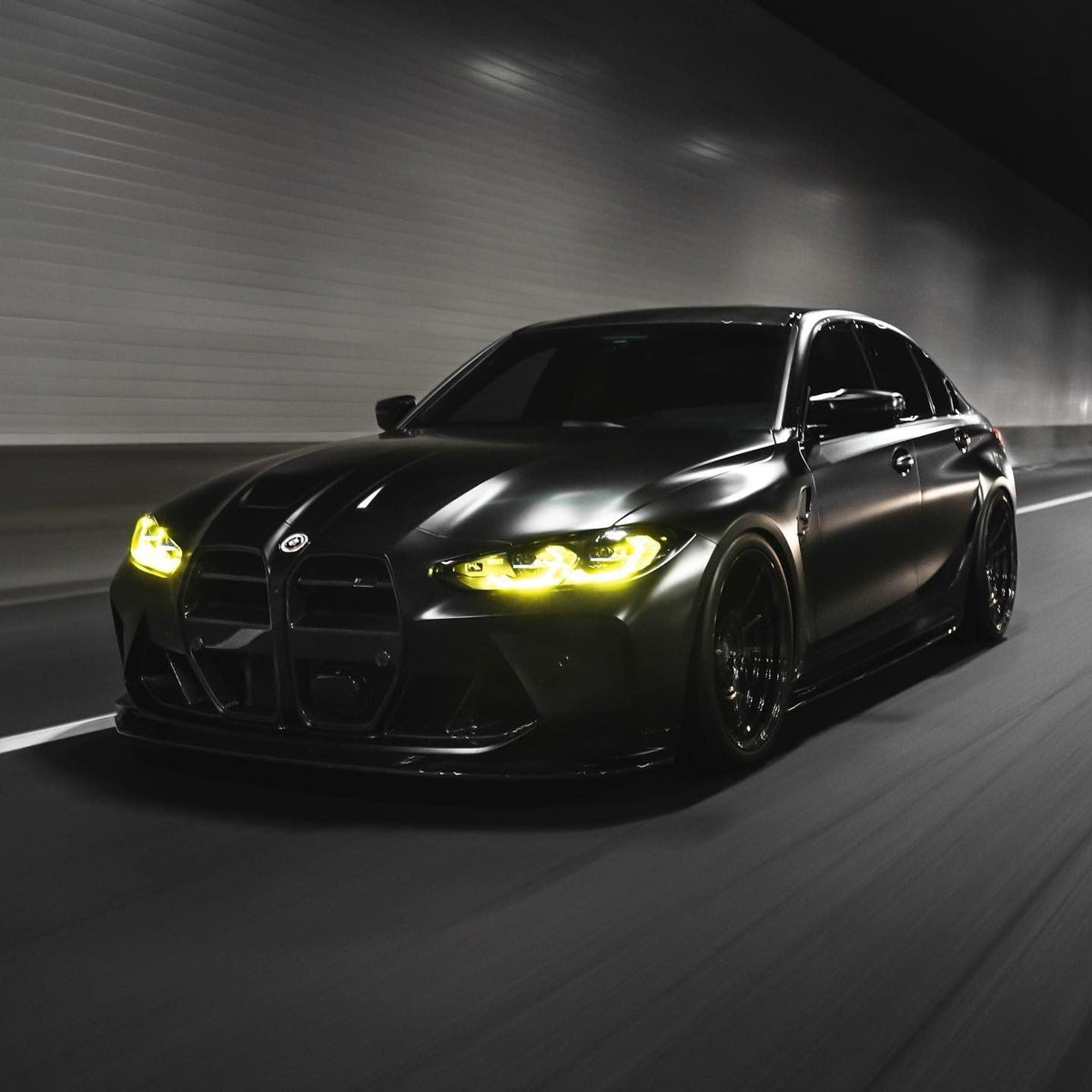
The BMW M3 exists because "good enough" wasn't good enough.
More power. More cooling. More chassis rigidity. Bigger brakes. Sharper responses. The entire point of an M3 is taking the foundation of a 3 Series and pushing the parts that matter to enthusiasts considerably further.
Then you turn on the stereo.
And suddenly, "good enough" seems to be back on the engineering brief.
✔ TL;DR
✔ The M3 receives enormous performance upgrades over the standard 3 Series, but its factory audio architecture largely follows the corresponding 3 Series generation.
✔ The F80 M3 shares its audio foundation with the F30 generation, while the G80 follows the G20 platform architecture.
✔ Even Harman Kardon doesn't necessarily solve the biggest limitation: the factory speakers themselves.
✔ Engine, exhaust, tire, and road noise make clean output especially important in an M car.
✔ For most M3 owners looking to improve clarity and detail, Stage One is the logical place to start.
✔ Ghost addresses the low-frequency side of the system, while Revenant Pro becomes relevant for owners who want to take amplification and control further.
Quick Answer
No, we don't think the factory M3 audio system completely matches the rest of the car.
Not because it's unusable. And not because BMW forgot how to build an audio system.
The problem is the standard set by the rest of the M3.
BMW extensively changes the regular 3 Series to create an M3, but the audio system doesn't receive an equivalent M-specific transformation. The F80 M3 follows the F30 audio architecture, and the current G80 M3 follows the G20 platform architecture. Even on the G80, the available Hi-Fi (S676A) and Harman Kardon (S688A) systems aren't some secret M Division audio system developed specifically because you bought an M3.
If you want the generation-by-generation technical breakdown, our BMW M3 and M4 Speaker Upgrade Guide goes deeper into F80, F82, G80, and G82 configurations.
Here, we're asking the more interesting question:
Does the audio experience actually feel appropriate for an M3?
An M3 Is Not Just a More Powerful 3 Series
This is what makes the audio situation interesting.
BMW doesn't create an M3 by taking a regular 3 Series, increasing the boost pressure, attaching an M badge, and calling everyone into the conference room to celebrate.
The transformation goes much deeper.
The powertrain changes.
The chassis changes.
The cooling requirements change.
The suspension changes.
The braking hardware changes.
The body is adapted to accommodate the performance underneath it.
Everything is built around a different expectation of the car.
The audio system is an exception.
Across both F80 and G80 generations, the M3's audio architecture is tied closely to the regular 3 Series platform from which the car is derived.
That's not necessarily unreasonable from BMW's perspective.
Developing an entirely separate audio architecture for an M3 would add cost and complexity to something that isn't central to the car's performance mission.
But from the driver's seat, it creates an odd mismatch.
You have a car engineered to make almost every input feel more immediate.
Then your music sounds... perfectly acceptable.
For an M3, acceptable feels unusually disappointing.
The M Badge Doesn't Upgrade the Speakers

This is the part that surprises some owners.
The M3's factory speakers don't receive the same kind of M-specific engineering treatment as the powertrain or chassis.
On the current G80, the audio system follows the G20 platform architecture. With Harman Kardon, the G80 uses the same underlying 464-watt amplifier architecture found in the corresponding G20 system rather than an M3-specific amplifier developed for the car.
That doesn't make Harman Kardon bad.
It means you need to separate two ideas:
A better factory audio package
and
an audio system engineered specifically to match an M3's performance level.
They're not necessarily the same thing.
If your M3 has Harman Kardon and you've wondered why it still sounds flatter or less detailed than you expected, our G20/G80 Sound System Upgrade Guide looks specifically at why the G-generation factory system can still leave performance on the table.
💡 Bavsound Insight
The M3 doesn't necessarily have a uniquely bad factory audio system.
It has an audio system that feels more disappointing because of the car surrounding it.
Put the same basic audio architecture into an ordinary commuter and "pretty good" might be enough. Put it into a car engineered around performance, precision, and driver involvement, and the weak link becomes much easier to notice.
An M3 Is Also a Harder Place for an Audio System to Work

There's another side to this.
An M3 isn't exactly a recording studio on wheels.
You have:
-
Wider performance tires
-
More road noise
-
More mechanical sound
-
A more prominent exhaust
-
More engine presence
-
A cabin designed around driving rather than acoustic isolation alone
And unlike some of those characteristics, you probably don't want them engineered out of the car.
The engine and exhaust are part of why you bought an M3.
But once you're cruising on the highway and want to listen to music, the audio system has to compete with all of it.
That makes clean output at real driving volumes especially important.
A factory speaker that sounds perfectly respectable while you're parked can become much less convincing once the car is moving and the cabin noise rises.
The natural reaction is to turn the volume up.
And that's often where the speaker limitation becomes more obvious.
Why More Volume Isn't the Same as Better Sound
Imagine you're driving an M3 on the highway.
Road noise rises.
The exhaust is present.
You increase the volume.
At first, everything simply gets louder.
Keep going and you may begin noticing something else:
Vocals lose definition.
The upper frequencies become harder.
Busy tracks start blending together.
Bass doesn't gain the authority you'd expect from the increase in volume.
That's the difference between output and clean output.
The system can make more sound without necessarily reproducing the music more convincingly.
This is particularly relevant in an M3 because you're more likely to ask the system to perform in an environment where there's already substantial acoustic competition.
And that brings us to the component actually producing the sound.
The Factory Speakers Are Where We'd Start
If your M3 sounds disappointing, it's tempting to assume you need a more powerful amplifier.
For most owners, we wouldn't start there.
The factory amplifier can only work with the speakers connected to it.
If those speakers are the component limiting clarity, detail, dynamics, or clean output, adding more amplification doesn't address the first bottleneck.
That's why our broader BMW audio upgrade path starts with speakers for most BMW owners.
The Stage One Speaker Upgrade replaces the factory drivers while retaining the BMW's existing speaker locations, factory-style connections, and original interior appearance.
No giant aftermarket grilles.
No speakers hanging out of the doors.
No reason for the inside of an M3 to suddenly look like someone discovered a car-audio catalog in 2004.
The point is to improve the part you hear without changing the part you see.
That's particularly important in an M3.
The cabin should still look like an M3 when you're finished.
What Should Actually Improve?
A good M3 audio upgrade shouldn't simply make the car louder.
You should be listening for improvements in:
Vocal clarity
Voices should feel more defined and less buried inside the rest of the track.
Instrument separation
When a recording gets busy, individual elements should remain easier to distinguish rather than collapsing into one mass of sound.
High-volume composure
As you turn the system up to compensate for road noise, the sound should remain controlled rather than becoming increasingly harsh or fatiguing.
Midrange presence
Guitars, vocals, percussion, and much of the information that gives music its character live here.
Soundstage
The presentation should feel less obviously tied to individual speaker locations and more like a coherent performance across the front of the cabin.
Those improvements matter in any BMW.
They matter even more in an M3 because the car asks more from the audio system while you're actually driving it.
But What If Clarity Isn't the Problem?
Then don't fix the wrong thing.
If you already like the clarity of your M3's system but keep thinking:
"Where is the low end?"
That's a different limitation.
BMW's underseat low-frequency drivers have to work within tight packaging constraints. If you want more depth, weight, and low-frequency authority, that's where the Ghost Underseat Subwoofer Upgrade comes into the conversation.

Stage One and Ghost aren't competing upgrades.
They solve different problems.
Our Stage One vs. Ghost guide breaks that distinction down in detail: Stage One addresses clarity, detail, and the main speaker performance, while Ghost addresses the low-frequency foundation.
For an M3 owner who wants the system to feel more complete, the combination makes considerably more sense than throwing random hardware at the car and hoping physics becomes cooperative.
💡 Bavsound Insight
Don't upgrade an M3 audio system by asking "What's the biggest upgrade I can buy?"
Ask "What am I actually missing?"
If it's clarity and detail, start with the speakers.
If it's low-end weight, address the underseat woofers.
If you've already strengthened those parts of the system and want greater power, dynamics, and control, then amplification becomes the next conversation.
Where Does Revenant Pro Fit?
Not first.
That's important.
Most M3 owners do not need to begin by replacing the amplifier.
Start by addressing the speakers that actually turn the amplifier's signal into sound.
If you've already built a stronger speaker system and want to take things further, the Revenant Pro Amplifier Upgrade becomes the logical next stage.
That's where you're moving beyond simply fixing the factory speaker limitation and toward extracting more performance from the complete system.
A sensible progression looks like:
Stage One → Ghost → Revenant Pro
Not because every M3 owner needs all three.
Because each one addresses a different part of the system.
So, Does the M3's Audio Match the Rest of the Car?
From the factory? Not quite.
The M3's problem isn't that BMW fitted an unusable stereo.
It's that the rest of the car sets an unusually high standard.
The steering has intent.
The chassis has intent.
The engine has intent.
The brakes have intent.
Everything about an M3 feels like somebody asked:
"How much better can we make this?"
The audio system feels more like somebody asked:
"Is the existing 3 Series architecture good enough?"
And technically, it is.
But that's not really the point of an M3.
FAQ
Does the BMW M3 have a different sound system from the regular 3 Series?
The M3 follows the audio architecture of its corresponding 3 Series generation rather than receiving an entirely separate M-specific audio system. The F80 is related to the F30 architecture, while the G80 follows the G20 platform.
Is Harman Kardon worth upgrading in an M3?
It can be. Harman Kardon improves the factory system, but the speakers can still become the limiting component. If you're satisfied with the features of the factory HK system but want greater clarity, detail, and composure, a speaker upgrade can address that limitation without replacing the entire audio architecture.
Should I upgrade Stage One or Ghost first in my M3?
If your main complaint is clarity, vocals, detail, or harshness at higher volume, Stage One is generally the first move. If your primary complaint is low-frequency depth and impact, Ghost may be the more relevant upgrade.
Do I need an amplifier when upgrading M3 speakers?
Not necessarily. For most BMW owners, Bavsound recommends addressing the speakers first rather than assuming an amplifier is required.
Will Ghost fit every BMW M3?
Fitment depends on the generation and factory configuration. Ghost fitment is established for F80 applications, while G80 owners should verify their exact configuration before ordering. The Build Your Kit tool is the safest way to confirm the correct components for your car.
Key Takeaways
✔ The M3 receives extensive performance engineering, but it doesn't receive an equally radical M-specific audio transformation.
✔ F80 audio architecture follows the F30 generation, while the G80 follows the G20 platform.
✔ The factory system can sound perfectly acceptable, but acceptable feels out of place in an M3.
✔ M-car road, engine, tire, and exhaust noise make clean output at real driving volumes especially important.
✔ For most owners chasing clarity and detail, Stage One is the logical starting point.
✔ Ghost addresses low-frequency depth and impact.
✔ Revenant Pro is the next step for owners who have already strengthened the system and want more power and control.
✔ You don't need to replace everything simply because you own an M3. Fix the limitation you can actually hear.
Ready to Find the Right Upgrade?
The right setup depends on whether you have an F80, G80, Hi-Fi, Harman Kardon, and the exact configuration BMW fitted to your car.
Use the Build Your Kit tool or email support@bavsound.com with your VIN and we will walk you through the right combination.
Share:
Apple Music vs. Spotify in a BMW: Which Settings Actually Matter?