


Good bass isn't simply more bass.
That's the mistake that makes a lot of car audio sound impressive for about thirty seconds and exhausting after that. Turn the bass up, make the mirrors shake, and call it an upgrade. The problem is that deep, powerful bass and uncontrolled, boomy bass are not the same thing.
In a BMW, getting bass right is about control, balance, and integration. The goal isn't to make the lowest frequencies dominate the cabin. It's to make them hit when they're supposed to, stop when they're supposed to, and blend naturally with the rest of the music.
 TL;DR
TL;DR
✔ Tight bass is about control, not simply output.
✔ Boomy bass happens when low-frequency energy isn't properly controlled or integrated.
✔ The speaker, enclosure, amplification, crossover, and cabin all affect bass quality.
✔ More bass doesn't necessarily mean better bass.
✔ BMW's underseat layout creates specific acoustic and packaging challenges.
Quick Answer
Tight bass sounds controlled, defined, and connected to the music. Boomy bass sounds like the low frequencies continue after the musical note has already stopped.
When a kick drum hits, tight bass gives you a defined impact. When a bass guitar moves between notes, you should be able to follow those individual notes rather than hearing one continuous rumble.
That difference comes down to several things working together:
The driver → the enclosure → the amplifier → the crossover → the cabin
A problem in any one of those areas can change the way the entire low end feels.
More Bass Doesn't Automatically Mean Better Bass
Let's start with the obvious misconception.
If you want more bass, you might assume the solution is simply to install a bigger subwoofer or turn up the bass setting.
But bass is not one thing.
There is a huge difference between:
More bass and Better bass.
A system can produce enormous amounts of low-frequency energy and still sound loose, muddy, or disconnected from the rest of the music.
A better system can actually sound less boomy while producing more bass.
That's because the goal isn't simply to generate more energy.
The goal is to control that energy.
💡 Bavsound Insight
More bass and better bass are two different things.
If you turn up the low end and the entire cabin starts sounding like one long note, you've increased output without necessarily improving the system.
Tight bass gives you the impact of the kick drum, the texture of the bass guitar, and the weight underneath the music without covering everything else up.
What Does "Tight Bass" Actually Mean?
"Tight" is one of those audio words people throw around constantly without explaining what they're actually hearing.
In practical terms, tight bass has a few recognizable characteristics.
The notes are easy to distinguish
A bass guitar playing one note shouldn't smear into the next one.
A kick drum should sound like a defined hit rather than a low-frequency thump that continues underneath everything.
The bass starts and stops cleanly
When the musical signal stops, the bass shouldn't feel like it's lingering around the cabin.
That's part of what people mean when they describe bass as controlled.
The bass feels connected to the rest of the system
Good bass shouldn't sound like it's coming from an entirely different audio system hidden somewhere else in the car.
It should feel like part of the same performance.
More volume doesn't turn it into noise
A good system should remain composed as you increase the volume.
That's particularly important in a BMW because you're often listening over road, tire, and mechanical noise.
The goal isn't simply:
"Can I hear the bass?"
It's:
"Can I still hear what the bass is actually doing?"
So What Makes Bass Boomy?
Boominess usually isn't caused by one magical "bad bass" component.
It's the result of low-frequency energy that isn't being controlled or integrated properly.
One of the biggest factors is the relationship between the driver and the enclosure.
A subwoofer isn't just a speaker sitting in a box.
The enclosure is part of the acoustic system.
A sealed enclosure, a ported enclosure, and BMW's compact underseat arrangements can all behave differently. The available space, enclosure design, and driver characteristics influence how the low frequencies are produced.
That's why simply choosing a subwoofer because it has a larger specification doesn't guarantee better bass.
The component has to make sense for the application.
Why BMW's Underseat Layout Matters
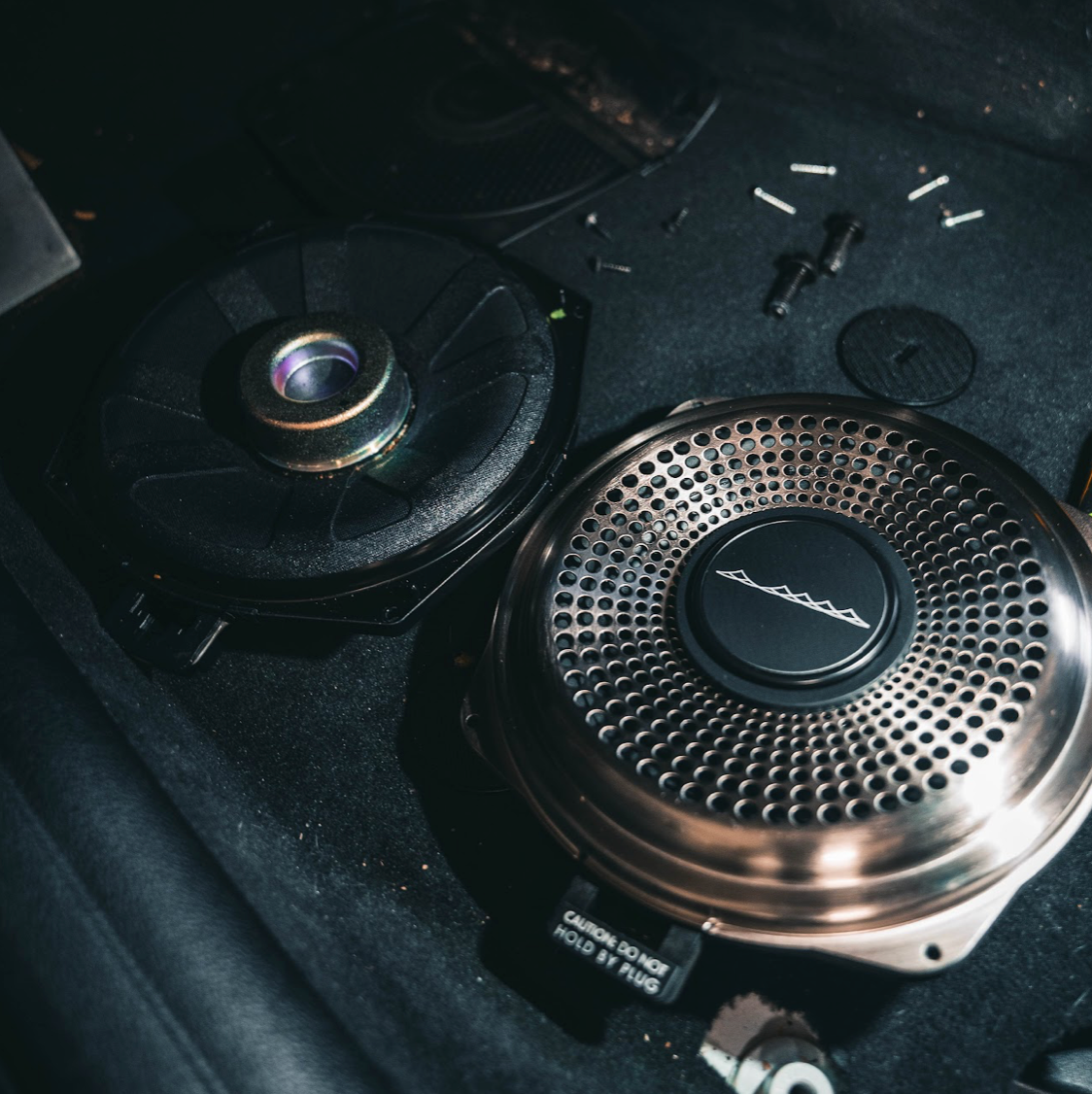
BMW's underseat subwoofer arrangement is a clever piece of packaging.
The low-frequency drivers sit beneath the front seats, giving the system bass capability without sacrificing valuable trunk space.
But that packaging also creates constraints.
There isn't room for a huge conventional subwoofer enclosure underneath the seat.
The driver has to work within the available space while integrating with the rest of the BMW audio system.
That makes vehicle-specific design important.
A generic subwoofer may produce more output, but more output isn't necessarily what you're missing.
You may need a driver that is designed to work properly within the BMW's existing space and system.
That's the philosophy behind the Ghost Underseat Subwoofer. It's designed specifically for BMW's underseat locations, targeting the low-end performance that the factory drivers can struggle to provide while retaining the original packaging approach.
If the main thing you're missing is depth, punch, and low-frequency authority, this is the part of the system worth looking at.
The Driver Has to Stay Under Control
A speaker produces bass by physically moving air.
The amount of control over that movement matters.
The driver needs to move enough air to reproduce low frequencies while remaining mechanically controlled.
If it can't do that cleanly, distortion increases and the bass can become less defined.
This is one reason you can't judge a subwoofer simply by looking at how much power it can handle or how much output it claims.
The useful question is:
How does it behave while reproducing the music?
A well-matched driver can deliver stronger bass while keeping individual notes easier to distinguish.
That's the difference between bass you feel and bass that simply takes over the cabin.
The Enclosure Matters More Than People Think
A subwoofer driver doesn't operate independently of its enclosure.
The enclosure influences how the driver behaves, particularly at low frequencies.
That's why two systems using apparently similar drivers can sound completely different.
Bavsound's Ghost vs. traditional subwoofer comparison goes deeper into this distinction and explains why the BMW underseat approach differs from a conventional trunk-mounted subwoofer.
For a BMW owner, that's an important consideration.
You're not trying to turn the car into a home-theater subwoofer installation.
You're trying to improve the low end within the architecture of the BMW.
The Crossover Keeps the System From Fighting Itself
Here's another part of the equation that gets overlooked.
Your main speakers and your subwoofer shouldn't both be trying to do exactly the same job.
The low-frequency handoff needs to be managed so that the different drivers work together rather than piling energy onto the same frequencies.
If that relationship isn't right, the result can sound thick or bloated.
When it's right, the subwoofer becomes much less obvious.
You don't sit there thinking:
"I can hear the subwoofer."
You think:
"The whole system sounds fuller."
That's what good integration sounds like.
Why Tight Bass Can Actually Sound Like Less Bass
This is one of the strangest things people discover after improving a system.
You expect:
BOOM.
Instead, you hear bass that is deeper, cleaner, and more controlled.
And your first thought might be:
"Is this actually louder?"
Maybe not.
But listen to the music.
Individual bass notes can be easier to distinguish. The kick drum has more definition. The low end feels fuller without constantly demanding your attention.
That's because controlled bass doesn't need to announce itself.
Boomy bass announces itself.
Good bass supports the music.
💡 Bavsound Insight
The best bass isn't necessarily the bass you notice first.
It gives the music weight without covering up everything else. You should hear the kick drum, bass guitar, and low-frequency detail more clearly, not simply hear more rumble.
What About Cabin Resonance?
The subwoofer isn't operating in isolation.
You're sitting inside a relatively small enclosed cabin with glass, trim, seats, doors, and other surfaces that interact with sound.
Low-frequency energy can also excite panels and create unwanted vibration.
That's where sound deadening can become relevant.
Bavsound's sound-deadening guide explains how treating panels can reduce unwanted vibration and resonance.
 But sound deadening isn't a replacement for a subwoofer.
It solves a different problem.
If your issue is:
"My bass isn't deep enough."
You're looking at the low-frequency system.
If it's:
"Something rattles every time the bass hits."
You're looking at vibration and resonance.
Sometimes both are happening.
How Do You Know If Your Bass Is Actually Boomy?
There are a few simple things to listen for.
1. Different bass notes sound almost identical
If every bass-heavy section produces essentially the same low-frequency thump regardless of what's being played, the system may not be reproducing the differences between notes very well.
2. Bass seems to continue after the hit
A kick drum should have a clear beginning and decay.
If the low end hangs around afterward, it can make the entire track feel less defined.
3. Turning the bass down makes everything else clearer
If reducing the bass suddenly makes vocals and instruments easier to hear, you've probably got too much low-frequency energy relative to the rest of the system.
4. The bass sounds impressive by itself but hurts the song
This is a big one.
If you hear the bass and think, that's a lot of bass, but the overall song sounds worse, you've increased output without improving integration.
The best test isn't whether the subwoofer sounds impressive on its own.
It's whether the entire song sounds better.
Where Does a Better Subwoofer Actually Help?
If the factory system sounds good through the mids and highs but you're missing depth, weight, or impact, the low-frequency section is the logical place to look.
That's where Ghost Underseat Subwoofers make sense.
The goal isn't simply to make the BMW louder.
It's to give the low end more authority while keeping it integrated with the rest of the system.
And because Ghost uses the existing underseat locations, you're not giving up the practicality of your BMW for the sake of a giant box in the trunk.
If you're unsure whether your problem is actually bass or whether the factory speakers are the bigger limitation, the Stage One vs. Ghost comparison explains the distinction clearly.
That's a useful distinction to make before buying anything.
💡 Bavsound Insight
Don't upgrade your BMW's audio system by asking, "What's the biggest subwoofer I can fit?"
Start with what you're actually hearing.
If the bass is weak, address the low end. If it's muddy because of resonance, address the environment. If the entire system lacks clarity, you may have a speaker problem instead.
The best upgrade is the one that fixes the actual limitation.
FAQ
What makes bass sound tight?
Tight bass comes from controlled driver movement, an appropriate enclosure, proper system integration, and a well-managed transition between the subwoofer and the main speakers.
Why does my BMW bass sound boomy?
Boomy bass can result from excessive low-frequency energy, cabin resonance, poor integration, or a driver and enclosure combination that isn't well suited to the vehicle.
Does more bass mean better bass?
No. More output can actually make a system sound less defined if the low frequencies aren't properly controlled.
Does a subwoofer make bass tighter?
A properly designed and matched subwoofer can improve both output and control. The result depends on the driver, enclosure, installation, and integration with the rest of the system.
Does sound deadening improve bass?
Sound deadening can reduce unwanted panel vibration and resonance, which can make the system sound cleaner. It doesn't replace a subwoofer or create additional low-frequency output.
Should I upgrade my BMW speakers or subwoofers first?
It depends on what you're hearing. If the main issue is clarity and detail, look at the speakers. If the speakers sound good but you're missing depth and impact, the low-frequency section is the more relevant place to start.
Key Takeaways
✔ Tight bass is controlled bass, not simply louder bass.
✔ The driver and enclosure work together to determine low-frequency behavior.
✔ Proper integration matters as much as raw output.
✔ Cabin resonance can contribute to unwanted boom and vibration.
✔ The right upgrade depends on what you're actually hearing.
✔ Ghost is designed to improve BMW's underseat low-frequency performance while retaining the factory location.
Ready to Get Better Bass From Your BMW?
If you're not sure whether your BMW needs more low-end output, better speaker performance, or something else entirely, start with your specific vehicle and audio system.
Use the Build Your Kit tool or email support@bavsound.com with your VIN and we will walk you through the right combination.
Share:
What Makes a BMW-Specific Speaker Different From an Aftermarket Universal Speaker?