


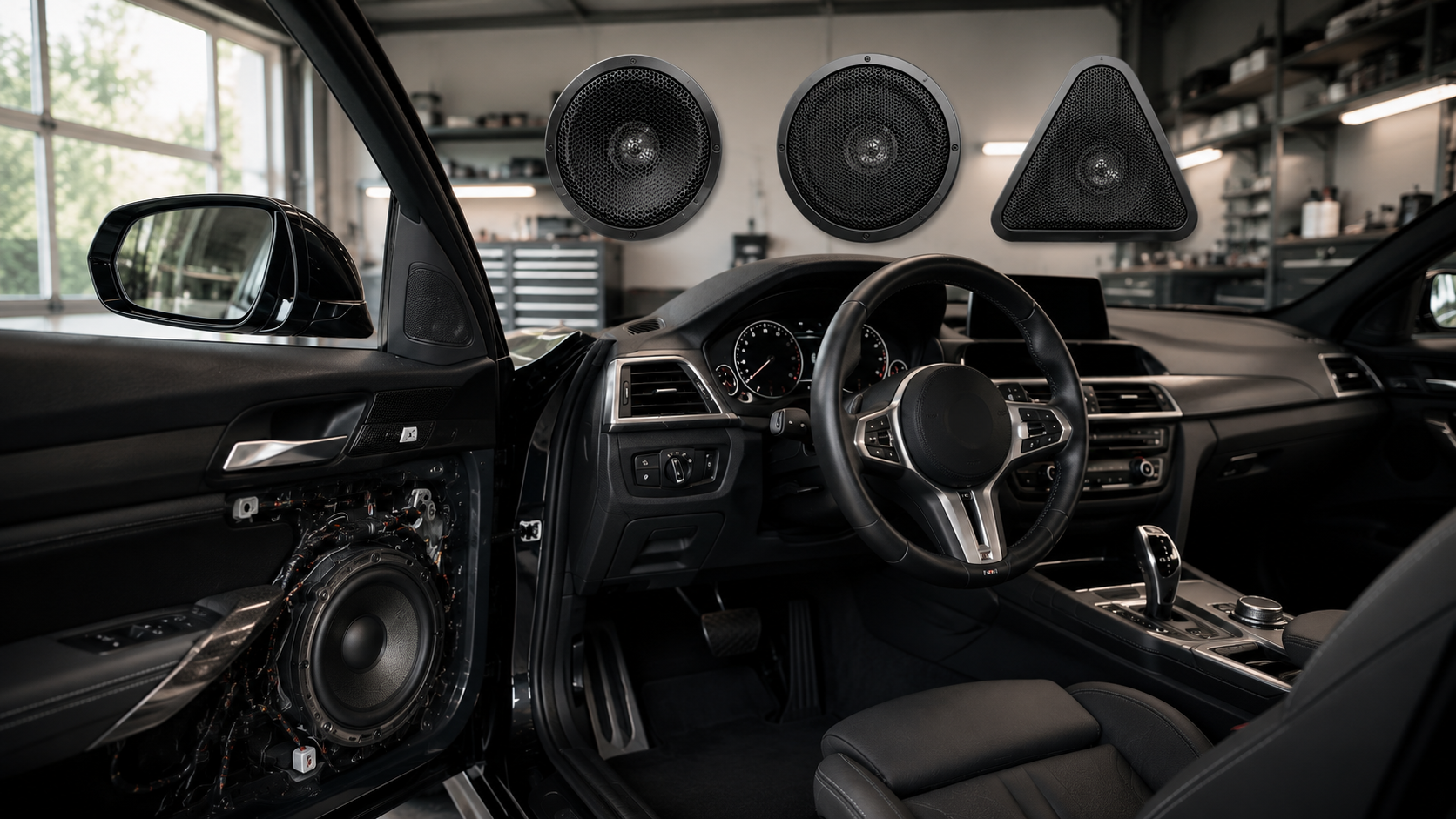
Walk into a car-audio shop and ask for a speaker that fits your BMW, and you'll probably get an answer pretty quickly.
That's because "fits" can mean a lot of things.
A speaker can physically go into the opening. It can be attached with an adapter. You can make the wiring work. The door panel can even go back on.
That doesn't necessarily mean the speaker was designed for your BMW.
And that's the important distinction.
TL;DR
✔ A universal aftermarket speaker is designed to work across many vehicles, while a BMW-specific speaker is engineered around a particular BMW application.
✔ Physical fit is only one part of the equation. Mounting depth, connector, impedance, efficiency, and speaker position all matter.
✔ BMW uses non-standard speaker dimensions and impedance values across different models and audio systems.
✔ A universal speaker may require adapter rings, wiring changes, or other modifications to work in a BMW.
✔ A BMW-specific speaker can be designed to work with the factory amplifier and mounting locations.
✔ The goal isn't simply to find a speaker that fits the hole. It's to find one that works correctly with the entire BMW audio system.

Quick Answer
A BMW-specific speaker is designed around the BMW it is going into. A universal aftermarket speaker is designed to be adaptable to many different vehicles.
That difference affects much more than installation.
A BMW-specific speaker can be engineered around:
-
The factory mounting dimensions
-
Available mounting depth
-
The factory connector
-
The BMW's speaker position
-
The factory amplifier
-
The required impedance
-
Speaker efficiency
-
The acoustic environment around the driver
A universal speaker starts from the other direction.
It's a speaker designed to work in a broad range of applications, with adapters and additional components used to make it fit individual vehicles.
That's why the question shouldn't simply be:
"Will this speaker fit my BMW?"
The better question is:
"Was this speaker designed to work with my BMW?"
"6.5-Inch" Doesn't Mean Your BMW Uses a 6.5-Inch Speaker

This is one of the easiest traps to fall into.
Search for BMW speaker sizes and you'll often see terms like:
4-inch
5.25-inch
6.5-inch
Those numbers can be useful when shopping for generic aftermarket speakers.
But they don't necessarily describe the actual dimensions of the BMW factory speaker.
BMW uses non-standard mounting dimensions, and those dimensions can vary by:
-
Chassis
-
Model year
-
Audio system
-
Speaker position
Our BMW Speaker Size Guide goes into this in much more detail, including why generic speaker-size charts can be misleading.
A speaker that is marketed as "6.5-inch" might technically be close enough to the opening to install with an adapter.
But the factory speaker may have a completely different basket shape, mounting geometry, depth, and connection.
That's where the problems begin.
Physical Fit Is More Complicated Than Diameter
Imagine replacing a BMW door speaker with a universal speaker.
You measure the opening.
The speaker looks like it will fit.
Problem solved?
Not quite.
You also need to consider mounting depth.
A speaker can have the correct approximate diameter and still be too deep for the space behind the door panel.
Then there's the basket.
Then the mounting holes.
Then the position of the cone relative to the grille.
Then the seal between the speaker and the mounting surface.
All of these details affect the result.
Bavsound's engineering process starts with the factory speaker dimensions for the specific application rather than treating the BMW as a generic speaker opening. That's why the Stage One Speaker Upgrade is built to use the factory mounting locations.
The difference is subtle when you're looking at the speaker.
It becomes considerably less subtle when you're trying to install it.
The Speaker's Position Matters Too
A speaker doesn't exist in isolation.
Where it's mounted inside the car affects what you hear.
A door speaker, dashboard speaker, rear-deck speaker, and underseat woofer are not performing the same acoustic job.
The surrounding cavity matters.
The available space matters.
The distance between the driver and the grille matters.
The direction the speaker is firing matters.
That's why a speaker that sounds excellent in one vehicle isn't automatically the right choice for another.
Bavsound's own engineering approach takes the specific speaker location and acoustic environment into account rather than designing one generic speaker and adapting it to everything.
That is the fundamental difference between vehicle-specific engineering and universal compatibility.
Then There's the Part You Can't See: Impedance
 This is where things get more interesting.
Two speakers can look almost identical and still behave very differently when connected to the same amplifier.
That's because of impedance.
BMW doesn't use one universal speaker impedance across every model and audio system. Factory BMW speakers can use different impedance values depending on the system and speaker position.
Our BMW Speaker Impedance Guide explains why 2-ohm, 4-ohm, and 8-ohm speakers can behave differently with a factory amplifier.
And this is one of the biggest problems with simply grabbing a universal aftermarket speaker.
Most aftermarket speakers are built around more standardized specifications.
BMW's factory system isn't necessarily.
The amplifier and speaker were designed to work together.
Change the speaker without accounting for that relationship and you can change how much power the amplifier delivers and how the system's output is distributed.
So even if the speaker physically fits, it may not be the correct electrical match.
Efficiency Matters Just as Much
Impedance isn't the whole story.
Efficiency matters too.
Imagine replacing a factory BMW speaker with a universal speaker that technically has a compatible impedance but requires substantially more power to produce the same output.
Your factory amplifier hasn't suddenly become more powerful.
The speaker simply isn't as efficient.
The result can be a system that doesn't perform the way you expected.
This is why BMW-specific speaker design isn't just about matching one number on a specification sheet.
The speaker needs to work within the limitations and characteristics of the amplifier already in the car.
Bavsound explains this distinction in its BMW audio upgrade guide, where the emphasis is on working with the BMW's existing architecture rather than treating the speakers as completely independent components.
Why Universal Speakers Often Need Adapters
Universal speakers are designed to work across many applications.
That's their strength.
You can buy one model of speaker and potentially install it into a variety of vehicles using the appropriate adapters.
But those adapters exist because the speaker itself wasn't designed specifically for your BMW.
You may need:
-
Adapter brackets
-
Mounting rings
-
Wiring adapters
-
Different connectors
-
Additional hardware
None of those things are inherently bad.
A skilled installer can make a universal speaker work.
But every additional interface introduces another variable.
Bavsound's approach is different.
The Stage One system is designed around the factory speaker location and factory connections so that the replacement can be installed without cutting the factory wiring or modifying the vehicle.
That's what "plug-and-play" should actually mean.
The Acoustic Seal Matters
Here's one detail that's easy to miss.
The speaker doesn't simply need to be attached to the door.
It needs to be properly coupled to the mounting surface.
If the mounting arrangement creates gaps or changes the relationship between the speaker and the door cavity, you can change the way the speaker behaves acoustically.
Bavsound's BMW speaker size guide specifically explains how adapter rings can change the distance between the speaker cone and the grille and can compromise the acoustic seal between the speaker and the door.
That matters particularly for low-frequency performance.
So a universal speaker with an adapter may technically be installed correctly while still producing a different acoustic result from a speaker designed around the original mounting geometry.
Why Factory Amplifier Compatibility Matters
 A BMW's factory audio system isn't simply:
Phone → amplifier → random speakers
The components were selected as part of a system.
The amplifier has specific output characteristics.
The speakers have specific electrical characteristics.
The system may also include factory crossover and equalization behavior.
That's why replacing one component can affect more than just that component.
A universal speaker might have an impedance or efficiency characteristic that doesn't play nicely with the factory amplifier.
A BMW-specific replacement is designed with that existing system in mind.
That's one of the fundamental reasons Bavsound describes Stage One as being engineered for the specific BMW and audio configuration, rather than simply selling a universal speaker that happens to fit a BMW opening.
Does BMW-Specific Mean "Better"?
Not automatically.
Being BMW-specific doesn't magically make a speaker good.
A badly designed speaker can be vehicle-specific and still sound terrible.
What matters is what the speaker has been engineered to do.
A proper BMW-specific speaker should account for the vehicle's:
-
Physical constraints
-
Electrical system
-
Factory amplifier
-
Mounting locations
-
Acoustic environment
-
Speaker configuration
Then the actual speaker design determines how well it performs.
That's an important distinction because "BMW-specific" is not itself a measure of sound quality.
It's an indication that the speaker was designed for the application rather than adapted to it.
Why This Matters More in Modern BMWs
BMW has never had one universal speaker configuration.
Different generations use different:
-
Speaker locations
-
Speaker sizes
-
Connectors
-
Impedance values
-
Audio systems
-
Amplifiers
Even two BMWs from the same model family can have different requirements.
A G20 isn't simply an F30 with a newer dashboard.
An F80 M3 isn't automatically interchangeable with a G80 M3.
That's why the Build Your Kit tool exists.
Instead of asking you to figure out which generic speaker size your BMW happens to resemble, it starts with the vehicle and determines the applicable system.
That's a much safer way to approach a BMW audio upgrade.
So What Is the Real Difference?
It comes down to the starting point.
Universal aftermarket speaker
Speaker first → adapt it to the vehicle
BMW-specific speaker
Vehicle first → design the speaker around it
That difference affects:
Fitment
Electrical compatibility
Installation
Acoustic performance
Factory-system integration
And ultimately, how predictable the finished result is.
A universal speaker can absolutely be made to work.
But if your goal is to improve a BMW without modifying the car around the speaker, a component designed specifically for that BMW gives you a much cleaner starting point.
A universal speaker isn't necessarily a bad speaker.
That's worth making clear.
There are plenty of excellent aftermarket speakers designed to work across different vehicles. The issue is that a good universal speaker still has to be adapted to a BMW's specific requirements.
And every time you adapt a component, you have to account for another variable.
That's where a BMW-specific speaker has an advantage.
 The Connector Shouldn't Be an Afterthought
One of the simplest differences is also one of the easiest to overlook.
The connector.
BMW uses vehicle-specific factory connectors, and they aren't necessarily the same connector you'll find on a universal aftermarket speaker.
With a universal speaker, you may need a wiring adapter or another connection method.
That can work.
But it means you're introducing another component into the installation.
A BMW-specific replacement can be designed around the factory connector from the beginning.
Bavsound's plug-and-play speaker approach is built around that principle: the speaker is developed from the factory component outward, including the connector, impedance, mounting dimensions, and acoustic environment.
The result is an installation that doesn't require cutting or splicing the factory wiring.
That's not just convenient.
It makes the installation more predictable.
The Factory Amplifier Changes the Equation
BMW owners sometimes assume that upgrading the speakers automatically means they need a new amplifier.
They don't.
At least, not necessarily.
The factory amplifier is already designed to drive the factory speaker system. If you replace those speakers with drivers that are engineered around the same system, you can often get a significant improvement without replacing the amplifier.
That's the philosophy behind the Stage One Speaker Upgrade.
The speaker is designed to work within the factory audio architecture rather than requiring you to rebuild that architecture around the speaker.
That matters because the amplifier, speaker, wiring, and factory processing are all part of one system.
Change one component intelligently and you don't necessarily have to replace everything else.
💡 Bavsound Insight
Plug-and-play doesn't mean "a speaker that happens to fit."
In a BMW, a true plug-and-play upgrade needs to account for the connector, impedance, mounting dimensions, and factory audio system.
The goal is to make the new speaker behave like it belongs in the car, not make the car adapt to the speaker.
The Installation Is Part of the Product

This is something that gets overlooked when comparing speakers by specifications alone.
Two speakers can have similar power ratings and frequency ranges but require completely different installation processes.
One might:
-
Bolt directly into the factory location
-
Use the factory connector
-
Require no wiring modifications
-
Preserve the original mounting geometry
The other might require:
-
Adapter brackets
-
Wiring adapters
-
Additional hardware
-
Modification to the mounting arrangement
Both may produce sound.
But they're not providing the same installation experience.
Bavsound's plug-and-play approach is specifically intended to keep the installation within the BMW's existing architecture.
That means the upgrade is also easier to reverse if you ever want to return the car to stock.
Why OEM+ Depends on Fitment
There's another reason BMW-specific design matters.
You bought a BMW partly because you like the way it was designed.
So why install an audio upgrade that makes the interior look like an aftermarket installation?
A good upgrade should improve what you hear without creating unnecessary visual changes.
That's the idea behind upgrading your BMW audio without making it look aftermarket.
The speaker should sit where the factory speaker sat.
The factory grille should still cover it.
The door panel should still fit properly.
Nothing should look like it was added after the car left the factory.
The best reaction to an OEM+ audio upgrade is usually:
"Something sounds different."
Not:
"What did you install in there?"
Does a BMW-Specific Speaker Always Sound Better?
Not automatically.
This is an important distinction.
Vehicle-specific design solves the application problem.
It doesn't automatically solve the engineering problem.
The actual speaker still needs to be well designed.
A BMW-specific speaker can be designed around:
-
The factory mounting location
-
The available enclosure volume
-
The amplifier
-
The impedance requirement
-
The connector
-
The acoustic environment
Then the driver itself needs to deliver the improvement you're looking for.
That's why the best comparison isn't:
"BMW-specific or universal?"
It's:
"Which speaker was engineered to perform correctly in this particular BMW?"
What You're Really Paying For
When you buy a universal speaker, you're primarily buying the speaker.
When you buy a BMW-specific speaker, you're buying the speaker plus the engineering around the application.
That includes figuring out:
-
What fits
-
Where it fits
-
How deep it can be
-
How it connects
-
What impedance it needs
-
How much power it receives
-
How it interacts with the factory system
-
How it sits behind the factory grille
That's a lot more than measuring the diameter of a hole.
Bavsound's engineering process starts with reverse-engineering the factory speaker and its application, then developing the replacement around those specifications. That's why the Stage One system is offered as a vehicle-specific upgrade rather than one universal BMW speaker kit.
When Does Universal Make Sense?
There are situations where a universal speaker can make perfect sense.
If you're building a completely custom system and you're comfortable with:
-
Fabricating brackets
-
Modifying mounting locations
-
Adapting wiring
-
Choosing amplifier loads
-
Tuning the system yourself
then universal components give you enormous flexibility.
That's part of their appeal.
But that's a different goal.
If your objective is:
"I want better sound without modifying my BMW,"
then a vehicle-specific, plug-and-play approach makes considerably more sense.
You aren't trying to build a custom audio installation.
You're trying to upgrade the BMW you already own.
The Bottom Line

A BMW-specific speaker isn't fundamentally different because it has some magical BMW-only cone material.
It's different because the entire speaker is engineered around the vehicle it is going into.
The mounting dimensions matter.
The connector matters.
The impedance matters.
The amplifier matters.
The acoustic environment matters.
And the way everything fits together matters.
A universal speaker can be adapted to a BMW.
A BMW-specific speaker starts with the BMW.
That's the distinction.
FAQ
Can I install a universal aftermarket speaker in my BMW?
Yes, in many cases, but you may need adapter brackets, wiring adapters, or other hardware because BMW uses non-standard mounting dimensions and connectors.
Are BMW-specific speakers better than universal speakers?
Not automatically. The advantage is that they're designed around the BMW's physical, electrical, and acoustic requirements rather than being adapted afterward.
Why can't I just use a 6.5-inch speaker in my BMW?
BMW factory speakers don't necessarily follow standard aftermarket speaker dimensions. A generic "6.5-inch" speaker may require an adapter and may not match the factory mounting depth or geometry.
Do BMW-specific speakers require an amplifier?
Not necessarily. A properly matched speaker can be designed to work with the factory amplifier. That's one of the advantages of a vehicle-specific upgrade.
Do I have to cut BMW wiring for an aftermarket speaker?
Not necessarily. Universal speakers may require wiring adapters, while a true plug-and-play BMW-specific speaker can use the factory connector without cutting or splicing the original wiring.
Does a BMW-specific speaker improve sound quality?
The vehicle-specific design ensures the speaker is physically and electrically appropriate for the application. The actual improvement depends on the quality of the replacement speaker and how it is engineered.
Key Takeaways
✔ A universal speaker is designed to be adaptable; a BMW-specific speaker is designed around the BMW.
✔ BMW uses non-standard speaker dimensions, connectors, and impedance values across different platforms and audio systems.
✔ Physical fit isn't enough. Electrical and acoustic compatibility matter too.
✔ Adapter rings and wiring adapters can make universal speakers work, but they can also change mounting geometry and installation complexity.
✔ A properly engineered BMW-specific speaker can use the factory mounting locations and connections for a cleaner, more predictable installation.
✔ "Will it fit?" is only the first question. "Will it work correctly with my BMW?" is the better one.
Ready to Find the Right Speaker for Your BMW?
BMW audio configurations vary by chassis, production year, and factory audio system, so the correct speaker isn't something you should have to guess at.
Use the Build Your Kit tool or email support@bavsound.com with your VIN and we will walk you through the right combination.
Share:
BMW M3 Audio: Does the Factory System Match the Rest of the Car?